
New September 2026 Eliminating Bias in Algorithmic Systems Act Targets Public Sector Algorithmic Accountability
Legislators and state governors are advancing new requirements for algorithmic accountability to curb bias in government AI systems. These updates signal a significant shift toward mandatory transparency and human-in-the-loop oversight in public sector digital services.
Published by
APEX AI Guardrails Editorial Team
September 26, 2026
Reading time
6
minutes
The newly introduced Eliminating Bias in Algorithmic Systems Act creates a rigorous federal standard for algorithmic accountability to identify and mitigate systemic bias in automated government decision-making. Introduced on September 18, 2026, the legislation responds to growing concerns regarding discriminatory outcomes in public-facing automated systems. This development forces state and local government IT leaders to re-evaluate their current AI deployment protocols to ensure full compliance with evolving federal standards.
How does the Eliminating Bias in Algorithmic Systems Act change federal AI oversight?
The Act, introduced September 18, 2026, mandates structured bias audits and heightened transparency for automated decision-making systems. By targeting discriminatory potential in algorithmic processing, the law moves beyond voluntary guidelines, pushing agencies to implement rigorous testing frameworks. This legislation aligns with broader efforts to unify federal AI standards, requiring that public sector entities demonstrate their systems operate fairly and equitably before they can be deployed for citizen-facing government services.
Legislative Momentum: Federal Oversight of Algorithmic Systems
The introduction of the Eliminating Bias in Algorithmic Systems Act represents a pivotal moment in the governance of automated tools within the federal landscape. According to official details from the CRI2026 - ELIMINATING BIAS IN ALGORITHMIC SYSTEMS ACT, the legislation seeks to codify the necessity of ongoing bias assessment as a fundamental aspect of digital administration. Public sector agencies are now facing a reality where transparency in code and training data is no longer optional but a regulatory prerequisite.
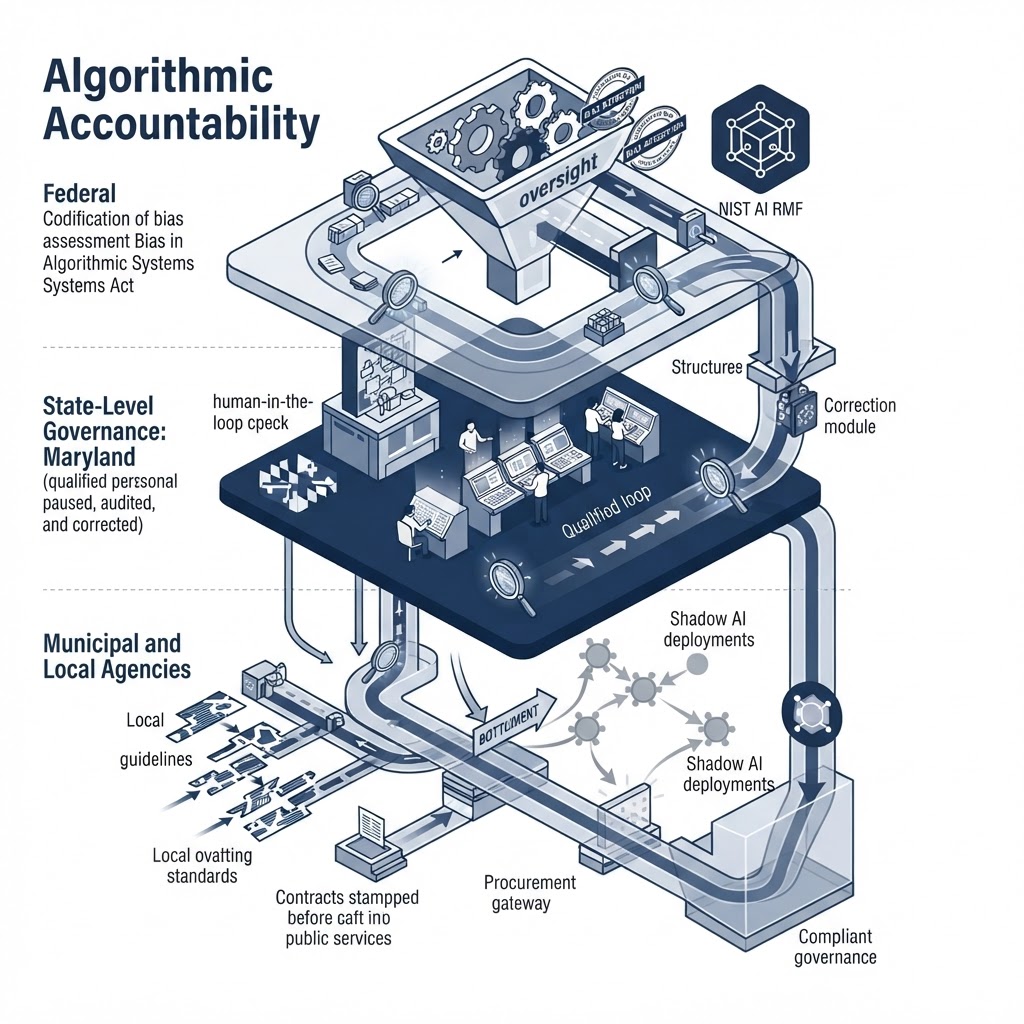
This federal push aligns with the ongoing White House strategy to replace the current fragmented patchwork of state and federal guidelines with a cohesive national legislative framework. As federal agencies prepare for these changes, IT leadership must prioritize the integration of bias detection tools that map directly to the NIST AI Risk Management Framework. The urgency of this act highlights the shift from experimental AI adoption to a structured, high-stakes compliance environment where accountability is measured by the ability to verify, report, and correct algorithmic performance across the entire government enterprise.
What steps must agencies take to meet new state-level AI bias testing requirements?
Agencies must implement mandatory bias testing, formal impact assessments, and maintain human-in-the-loop oversight for high-risk AI deployments. Following Maryland's model, public sector leaders should integrate these requirements into their procurement lifecycle. This ensures that third-party vendors are vetted for potential bias before implementation. By documenting these checks, agencies demonstrate compliance with evolving governance standards while simultaneously protecting against the legal and ethical risks associated with automated algorithmic decisions.
State-Level Governance: Maryland’s New AI Strategy
Maryland is setting an immediate precedent for SLED agencies by requiring that high-risk AI tools undergo stringent impact assessments and human oversight. As reported on September 22, 2026, Maryland Gov. Moore unveiled a new AI strategy that prioritizes civil rights protections and technical accountability.
This model mandates that automated systems influencing human services—such as benefits, housing, or healthcare—must be audited for bias before and during their active lifecycle. For state IT teams, the implementation of this strategy serves as a practical blueprint for operationalizing the NIST AI RMF. The focus on human-in-the-loop requirements ensures that while AI may assist in data processing, final determinations on sensitive matters remain with qualified personnel.
This approach effectively mitigates the risk of shadow AI and uncontrolled algorithmic drift by keeping governance centralized within clear executive policy. As other states monitor Maryland’s progression, the standard for responsible AI in the public sector is rapidly moving toward this proactive, audit-heavy approach to ensure that technological innovation does not inadvertently compromise the constitutional rights or equity of the populations these systems serve.
Navigating the Compliance Path for Municipal and State Agencies
Municipal and local agencies must now prepare for a future where national standards and state-specific mandates overlap in complex ways. As discussed in recent insights on Where AI Regulation Stands Today, the current regulatory environment remains in flux as the White House pushes for a uniform national framework to resolve jurisdictional gaps. For IT leaders, this creates a dual pressure: ensuring compliance with emerging state AI governance charters while preparing for the potential arrival of a federal legislative mandate.
Procurement processes are the most critical point of vulnerability, as agencies must now build 'algorithmic accountability' into contract requirements for all new technology vendors. Simply trusting a vendor's internal documentation is no longer sufficient. Agencies should establish robust AI acceptable use policies that dictate how algorithms are audited and monitored for bias throughout their usage.
This transformation requires not only technical adjustments to AI DLP (Data Loss Prevention) and monitoring tools but also a cultural shift toward transparency. Local government leaders must recognize that the ability to explain, audit, and justify an automated decision will soon be a mandatory requirement for maintaining public trust and avoiding costly litigation related to discriminatory AI outcomes.
Actionable Strategies for Public Sector AI Governance
- →Establish a cross-functional AI governance council to review high-risk deployments before acquisition. • Incorporate mandatory bias audit clauses into all new public sector technology procurement contracts. • Pilot the use of human-in-the-loop oversight protocols for all automated human services eligibility engines. • Align internal AI usage guidelines with the NIST AI RMF to ensure consistency with federal standards. • Conduct regular inventory checks of existing systems to eliminate undocumented 'shadow AI' deployments. • Document all algorithmic impact assessments to provide evidence of compliance during future audits.
What is the primary consequence for agencies failing to maintain algorithmic accountability under these new standards?
Failure to maintain accountability can lead to severe legal, financial, and reputational consequences, including litigation regarding discriminatory outcomes and potential loss of federal funding. If an automated system produces biased results in areas like healthcare or public safety, agencies may face civil rights challenges. Regulatory bodies are increasingly likely to enforce sanctions on agencies that lack verifiable evidence of bias testing, impact assessments, and clear human oversight mechanisms.
The alignment of federal legislation with state-level innovation marks a new era where algorithmic accountability is the primary indicator of successful public sector digital transformation. Leaders must prioritize systemic bias testing and transparent governance to ensure they remain ahead of the rapid regulatory shifts occurring this September. Proactive engagement with these new standards today will define the viability of an agency’s AI strategy for the decade ahead.
Tagged
About APEX AI Guardrails: We publish expert AI news and governance insights updated 4× daily. Our editorial team consists of retired government IT professionals, AI governance specialists, and compliance experts with deep experience in local government operations.
Related Articles
AI Governance
Mitigating AI Hallucination Risk in Government: New October 19 Federal Oversight Trends
October 19, 2026
AI Governance
Combating AI Deepfake Disinformation: How Government Agencies Can Restore Public Trust as of October 19, 2026
October 19, 2026
AI Governance
New Federal AI Systems Transparency Act Introduced Amid Growing Regulatory Pressure
October 19, 2026