
Combating AI Deepfake Disinformation: How Government Agencies Can Restore Public Trust as of October 19, 2026
Government agencies face an urgent need to counter AI-driven deepfake disinformation through zero-trust architectures and stricter guardrails. Learn how to secure public trust amidst the rapid proliferation of synthetic media threats.
Published by
APEX AI Guardrails Editorial Team
October 19, 2026
Reading time
6
minutes
AI deepfake disinformation threats have surged, forcing government agencies to confront critical vulnerabilities in the information ecosystem. As research from the Harvard Business Review and Appian indicates, while 92% of organizations recognize that autonomous systems require guardrails, less than 50% have successfully deployed them. This discrepancy creates a significant risk for public sector IT and compliance leaders seeking to maintain institutional integrity.
How are foreign adversaries leveraging machine-manipulated media to destabilize democratic processes?
Foreign actors utilize deepfake technology to manufacture disinformation, such as the incident where state-aligned media broadcast audio-faked footage to implicate officials in violent events, as documented in AI Incident 656. Federal law, specifically 50 USC 3369a), now mandates that the Director of National Intelligence formally report on these weaponized media tactics to assess national security impacts.
The Mounting Governance Gap in Public Sector AI
The rapid adoption of artificial intelligence has outpaced the implementation of rigorous internal oversight mechanisms within many agencies. Despite widespread acknowledgment that AI agents require robust controls, the current governance landscape remains fragmented, leaving many departments exposed to the consequences of unvetted synthetic content. Agencies are increasingly looking toward a zero-trust model to address these failures, moving away from relying on the inherent honesty of models toward a design philosophy that prioritizes constant verification.
As highlighted by Federal News Network, the current approach to AI governance often lacks the necessary enforcement to prevent misinformation from impacting public perception. Procurement teams are now shifting their evaluation criteria to match emerging industry standards, focusing on vendor transparency and the technical capability to detect AI-generated audio or video. This pivot is essential for aligning with the broader NIST AI RMF guidelines, which emphasize that technical robustness must be paired with clear, transparent accountability frameworks.
Without such measures, agencies risk failing their mandate to provide accurate information to the citizens they serve, effectively becoming conduits for state-sponsored disinformation campaigns that threaten to undermine public confidence in democratic institutions and administrative digital communications.
What does the zero-trust approach to AI involve for government compliance teams?
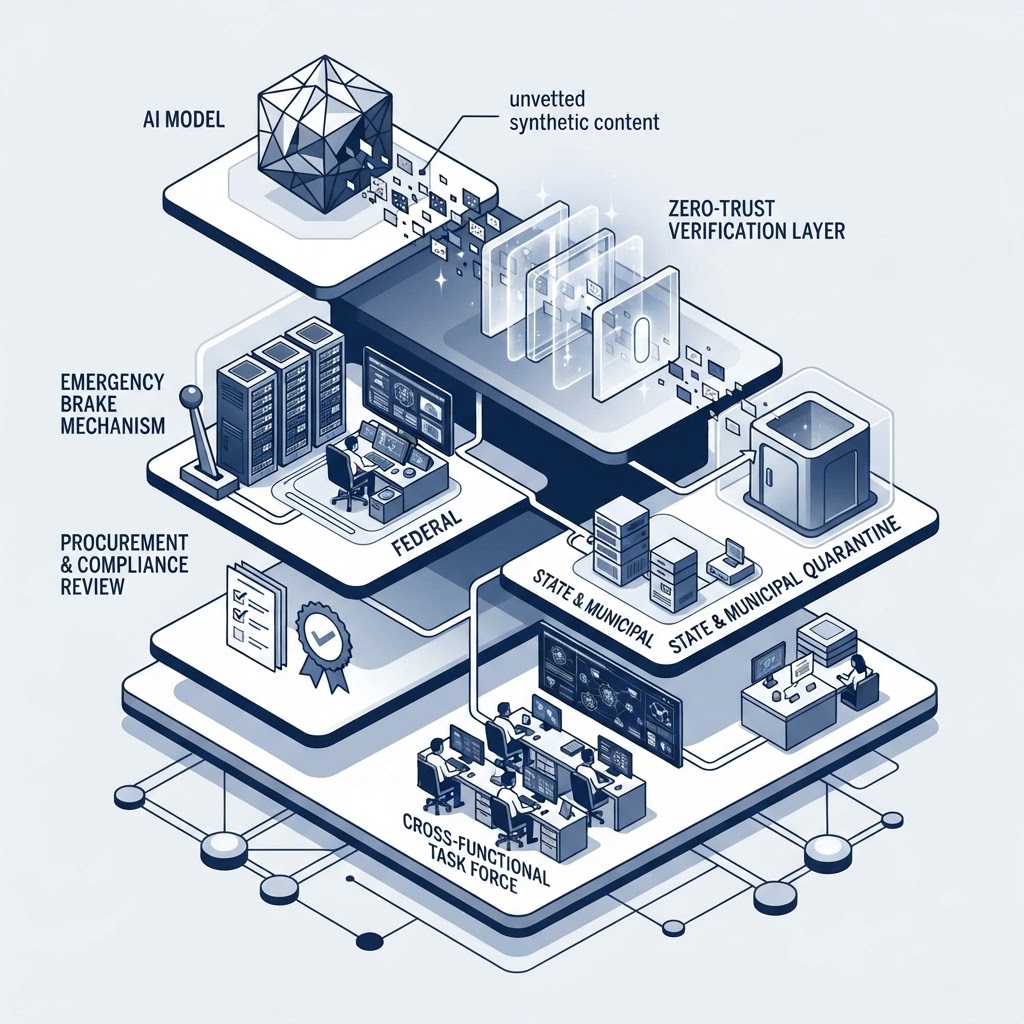
Microsoft CEO Satya Nadella’s AI Trust Plan advocates for a zero-trust architecture that assumes AI models are inherently fallible. Compliance teams should implement secondary control layers and manual 'emergency brake' mechanisms that can suspend automated operations if anomalies are detected. This approach ensures that oversight is not dependent on the model itself, but rather on rigid, human-in-the-loop validation processes that confirm the authenticity of disseminated information.
Addressing AI Deepfake Disinformation Through Architectural Safeguards
The shift toward zero-trust in public sector technology is not merely a theoretical exercise; it is a tactical response to the proliferation of high-fidelity synthetic media. By surrounding AI models with external monitoring, agencies can effectively isolate potential misinformation before it reaches the public. According to the AI Trust Plan, the integration of model-agnostic safeguards allows for a containment strategy that functions regardless of how an AI system was trained.
This is crucial for protecting the integrity of digital communications, as federal agencies are now required to account for the malicious use of deepfakes under existing intelligence reporting statutes. Compliance officers must prioritize the adoption of provenance-tracking technologies that can verify the origin of digital assets, ensuring that any information attributed to a government agency has been cryptographically signed. Furthermore, the lack of standardized authentication across federal departments remains a significant gap that sophisticated adversaries are currently exploiting to erode trust.
Establishing these guardrails requires a fundamental redesign of existing AI acceptable use policies, moving from passive compliance to active, real-time threat detection and mitigation strategies.
Implementing Resilient AI Defenses at the Municipal and State Level
State and local entities operate on the front lines of public communication and face unique pressures when addressing AI deepfake disinformation threats. Unlike large federal departments, smaller jurisdictions often lack the resources for custom-built, secure AI infrastructure, making them susceptible to third-party vendor weaknesses. Procurement departments must now enforce stricter requirements for vendors to prove they have integrated emergency brake capabilities and robust data loss prevention (DLP) tools within their offerings.
State agencies should formalize an AI governance charter that specifically addresses the threat of synthetic media in official social channels and press releases. This includes mandatory staff training sessions focused on identifying AI-generated content through forensic detection tools and maintaining strict adherence to verify-first protocols. Furthermore, municipalities can leverage inter-agency collaboration to share threat intelligence regarding active disinformation campaigns, effectively pooling resources to identify and counter harmful content that may be localized in its impact.
By embedding AI governance into standard procurement cycles, local governments can ensure that they are not just buying technology, but are also purchasing the safety and operational integrity that the public expects from government services.
Strategic Priorities for Ensuring Algorithmic Accountability
- →Integrate zero-trust verification layers into all mission-critical AI workflows to prevent unauthorized data manipulation. • Adopt model-agnostic emergency brake mechanisms that allow for the immediate suspension of AI outputs identified as deepfake disinformation. • Enforce strict procurement guidelines that require vendors to demonstrate both transparency and provenance-tracking for all AI-generated content. • Align departmental AI governance charters with NIST AI RMF standards to ensure consistent algorithmic accountability across state and federal boundaries. • Establish dedicated cross-functional task forces to monitor and report potential foreign-weaponized media impacts as defined in 50 USC 3369a).
What is the potential consequence for agencies failing to manage AI misinformation risks?
Failing to implement guardrails exposes agencies to severe reputation damage and the risk of disseminating state-sponsored propaganda. As Federal News Network highlights, the current trust gap is widening. Consequences include a degradation of public service efficacy, potential violations of statutory mandates regarding national security, and loss of institutional control over critical communications channels, making the agency a target for exploitation.
Addressing AI deepfake disinformation threats requires an immediate transition to verified, zero-trust architectures across all government layers. By prioritizing model-agnostic safeguards and rigorous procurement standards, agencies can proactively secure their digital operations against foreign-aligned manipulation. Compliance leaders must act decisively today to ensure that public trust remains firmly grounded in verifiable, authentic information.
Sources
- Government has a trust problem with AI. Here’s how to address it. - Federal News Network
- [Satya Nadella's AI Trust Plan: 6 Safeguards [2026] - Tech Insider](https://tech-insider.org/nadella-ai-trust-emergency-brake-safeguards-2026/)
- 50 USC 3369a: Report on deepfake technology, foreign weaponization of deepfakes, and related notifications)
- Purported Deepfake Disinformation Aired on… – AI Incident 656
Tagged
About APEX AI Guardrails: We publish expert AI news and governance insights updated 4× daily. Our editorial team consists of retired government IT professionals, AI governance specialists, and compliance experts with deep experience in local government operations.
Related Articles
AI Governance
Mitigating AI Hallucination Risk in Government: New October 19 Federal Oversight Trends
October 19, 2026
AI Governance
New Federal AI Systems Transparency Act Introduced Amid Growing Regulatory Pressure
October 19, 2026
AI Governance
Algorithmic Accountability in the Public Sector: October 19 Update on New Fairness Frameworks
October 19, 2026