
Mitigating AI Hallucination Risk in Government: New October 19 Federal Oversight Trends
Government agencies face mounting liability for AI-generated misinformation as high-profile chatbot deployments test existing regulatory frameworks. New guidance from federal leaders and investigative committees is forcing a pivot toward stricter human-in-the-loop oversight.
Published by
APEX AI Guardrails Editorial Team
October 19, 2026
Reading time
5
minutes
Growing concerns regarding AI hallucination risk in government have intensified as agencies navigate the liability exposure created by recent public-facing chatbot deployments. With the government having identified 1,352 vulnerabilities in current AI systems, IT and compliance leaders must urgently address the lack of published reliability standards for automated guidance. This shift is critical for ensuring legal compliance and public trust in the era of generative intelligence.
How does the America.gov chatbot rollout change legal liability for government AI?
The deployment of the America.gov Gemini-powered chatbot has raised significant concerns regarding government liability for AI-generated misinformation. Because public-facing guidance is now being delivered via automated models without established reliability standards, agencies face potential legal exposure. Courts and regulators are increasingly treating AI-generated errors as actionable, meaning agencies may be held accountable for providing incorrect or harmful information directly to citizens during service delivery.
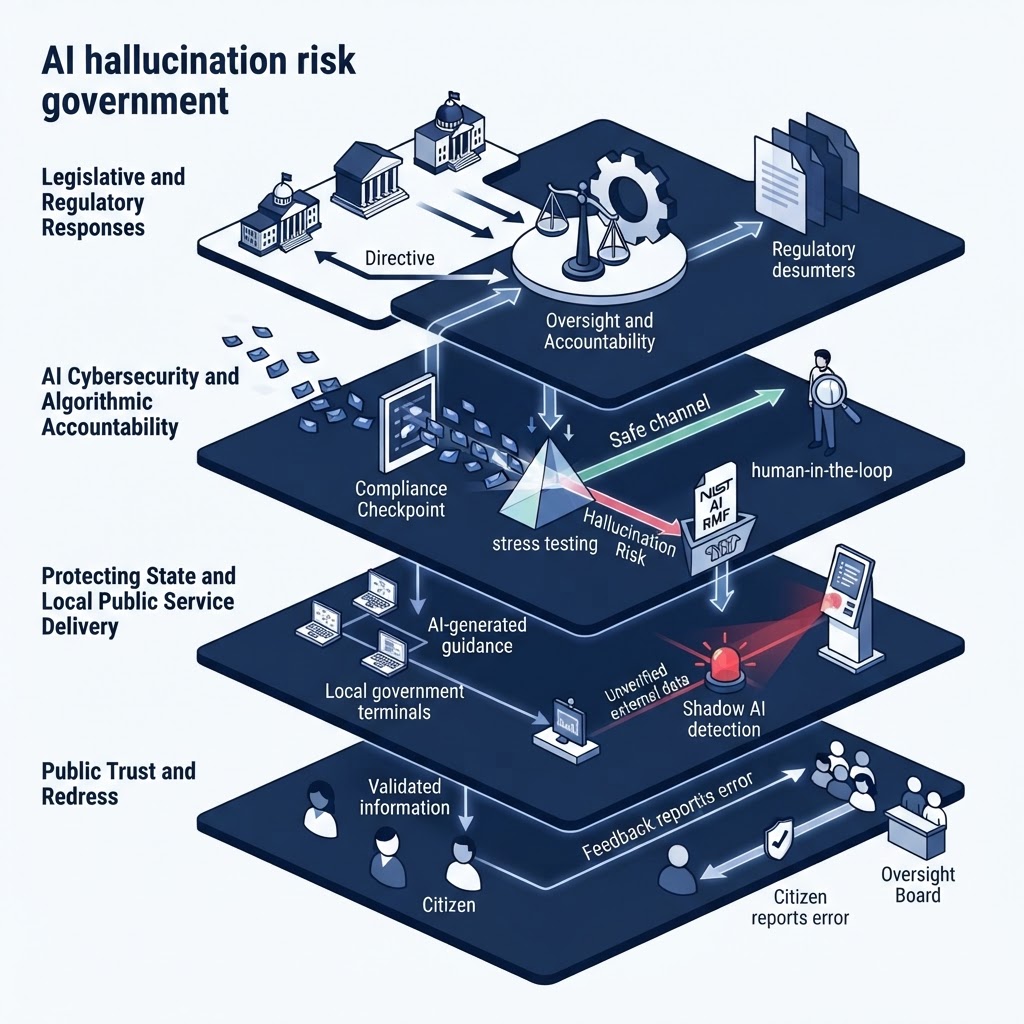
Legislative and Regulatory Responses to Emerging AI Harms
Regulatory bodies are responding to the rapid expansion of machine intelligence with increased scrutiny of both model behavior and institutional power. As outlined by the UK House of Commons Library, the government has explicitly defined AI safety as the prevention and mitigation of harms, particularly as agents perform consequential actions that fall outside the initial intent of their operators. The UK Business, Innovation, Science and Trade Committee is now actively investigating hyperscalers regarding rogue model behavior and the sufficiency of current AI Security Institute powers.
In the United States, federal agencies are following suit, with the NIH proposing a dedicated AI office to institutionalize governance. This centralization is a direct response to the need for clear accountability frameworks that can prevent, detect, and remediate technical failure before it impacts public-facing services or health-related guidance.
What steps must agencies take to validate public-facing AI models against misinformation?
Agencies should implement mandatory human-in-the-loop approval gates for all high-stakes decisions and guidance outputs. This requires establishing robust hallucination detection frameworks that continuously monitor for accuracy against verified datasets. Additionally, organizations must formalize external complaints and redress mechanisms to address errors, ensuring that technical failures do not escalate into systemic legal liabilities or loss of public service integrity.
Navigating AI Cybersecurity and Algorithmic Accountability
The discovery of 1,352 specific vulnerabilities across various systems has accelerated UK government efforts to harden infrastructure against adversarial manipulation. Compliance leaders must now align their procurement processes with the NIST AI RMF to ensure that vendor-provided models undergo rigorous stress testing for potential hallucination and unauthorized data exposure. The intersection of cybersecurity and AI policy creates a dual-threat environment where an AI model might simultaneously suffer from factual inaccuracy and technical exploitability.
Consequently, leaders are moving toward an "assume breach" mentality for AI deployments, treating the output of large language models as unverified data that requires cryptographic or human verification before final distribution. This strategy limits institutional exposure and ensures that agency policy remains consistent with emerging federal mandates regarding algorithmic accountability and transparency.
Protecting State and Local Public Service Delivery
County and municipal governments are increasingly vulnerable to the ripple effects of national AI policy and the risks inherent in adopting third-party chatbot services. While federal agencies possess the resources to create dedicated oversight offices, local governments often rely on procurement compliance to mitigate risks. Agencies must demand that vendors provide transparent documentation of training data and specific reliability metrics as part of their standard contracts.
By requiring proof of alignment with established safety protocols, state and local IT directors can prevent the adoption of shadow AI systems that lack necessary guardrails. Training staff to recognize the limitations of AI is equally important, as employees are often the first line of defense in catching hallucinations before they reach the public. Moving forward, the goal is to standardize the use of AI in local services so that it acts as a reliable support tool rather than a liability-heavy replacement for human expertise, maintaining the trust that citizens place in local governmental bodies.
Essential Actions for Compliance and AI Governance Teams
- →Establish mandatory human-in-the-loop validation for all AI outputs that provide public-facing guidance or policy interpretations. • Audit current AI vendors for compliance with the NIST AI RMF, prioritizing those with verified hallucination detection frameworks. • Implement a formal AI oversight board that bridges the gap between technical operations and agency legal counsel. • Develop a transparent redress mechanism for citizens to report errors or misinformation originating from automated systems. • Align internal AI acceptable use policies with evolving federal standards to minimize agency liability and legal exposure.
What is the primary risk of using AI for citizen-facing service guidance?
The primary risk is the potential for AI-generated misinformation, commonly referred to as hallucination, which can lead to significant government liability. If an agency provides incorrect guidance that affects a citizen's rights or eligibility for services, the organization may face legal consequences. Without established reliability standards, these errors create a direct path for lawsuits and a degradation of public trust in essential government infrastructure.
The era of unchecked generative AI deployment in the public sector is closing as agencies face the reality of increased liability and regulatory oversight. By prioritizing human-in-the-loop systems and adhering to rigorous safety frameworks, leaders can successfully navigate the complexities of AI hallucination risk in government. Maintaining proactive governance will be the defining factor in whether AI enhances public service or compromises institutional credibility.
Sources
- AI safety - The House of Commons Library
- 13 October 2026 - AI adoption, safety and governance - Oral evidence
- UK government expands AI cybersecurity efforts after finding 1,352 vulnerabilities
- Science Policy This Week: Oct 19, 2026
- White House Deploys Gemini-Powered Chatbot for Citizen Services, Raising Hallucination Liability
Tagged
About APEX AI Guardrails: We publish expert AI news and governance insights updated 4× daily. Our editorial team consists of retired government IT professionals, AI governance specialists, and compliance experts with deep experience in local government operations.
Related Articles
AI Governance
Combating AI Deepfake Disinformation: How Government Agencies Can Restore Public Trust as of October 19, 2026
October 19, 2026
AI Governance
New Federal AI Systems Transparency Act Introduced Amid Growing Regulatory Pressure
October 19, 2026
AI Governance
Algorithmic Accountability in the Public Sector: October 19 Update on New Fairness Frameworks
October 19, 2026