
New Algorithmic Accountability Act Introduced: What SLED Leaders Need to Know
The U.S. Government Publishing Office has officially recorded the federal Algorithmic Accountability Act as of September 29, 2026. This shift mandates that SLED agencies adopt rigorous transparency and auditing practices to ensure equitable AI deployment.
Published by
APEX AI Guardrails Editorial Team
October 3, 2026
Reading time
6
minutes
# New Algorithmic Accountability Act Introduced: What SLED Leaders Need to Know
The U.S. Government Publishing Office officially recorded the Algorithmic Accountability Act on September 29, 2026, marking a pivotal transition from voluntary ethics to mandatory oversight for public sector technology. This legislation coincides with state-level mandates, such as the Connecticut Artificial Intelligence Responsibility and Transparency Act, which became enforceable on October 1, 2026.
Understanding these frameworks is now critical for government IT and compliance leaders to mitigate legal exposure and maintain public trust while deploying autonomous services.
How does the federal Algorithmic Accountability Act change compliance requirements for state and local government agencies?
The Act mandates formal algorithmic impact assessments and audit trails for high-stakes public sector AI deployments. It effectively ends the era of voluntary ethics by codifying transparency requirements at the federal level. Agencies must now ensure that any AI system used in public service operations—particularly those affecting civil rights or resource allocation—undergoes documented bias testing and meets specific federal oversight standards recorded by the U.S. Government Publishing Office as of September 2026.
Shifting Toward Mandatory Federal and State AI Compliance
The introduction of the Algorithmic Accountability Act represents a sea change in how public sector organizations govern artificial intelligence. For years, SLED agencies relied primarily on informal, voluntary ethics guidelines, but the landscape shifted permanently on September 29, 2026, when the federal mandate was officially recorded CRI2026 - ALGORITHMIC ACCOUNTABILITY ACT. This federal action is complemented by aggressive state-level legislation; for instance, the Connecticut Artificial Intelligence Responsibility and Transparency Act commenced its enforcement period on October 1, 2026 2026 AI Compliance: Upcoming Laws Every Organization ....
These overlapping jurisdictions require agencies to move beyond experimental AI pilots and adopt structured, documented compliance frameworks. Procurement teams are now tasked with ensuring that any third-party software vendors possess the technical documentation required to prove compliance with these new statutes. Failure to align with these federal and state benchmarks creates not only a risk of litigation but also a threat to the institutional legitimacy of digital government services.
Leaders must prioritize these new reporting requirements to stay ahead of regulatory scrutiny and avoid operational stalls in critical agency programs.
What is the first step for an agency trying to comply with the October 2026 transparency mandates?
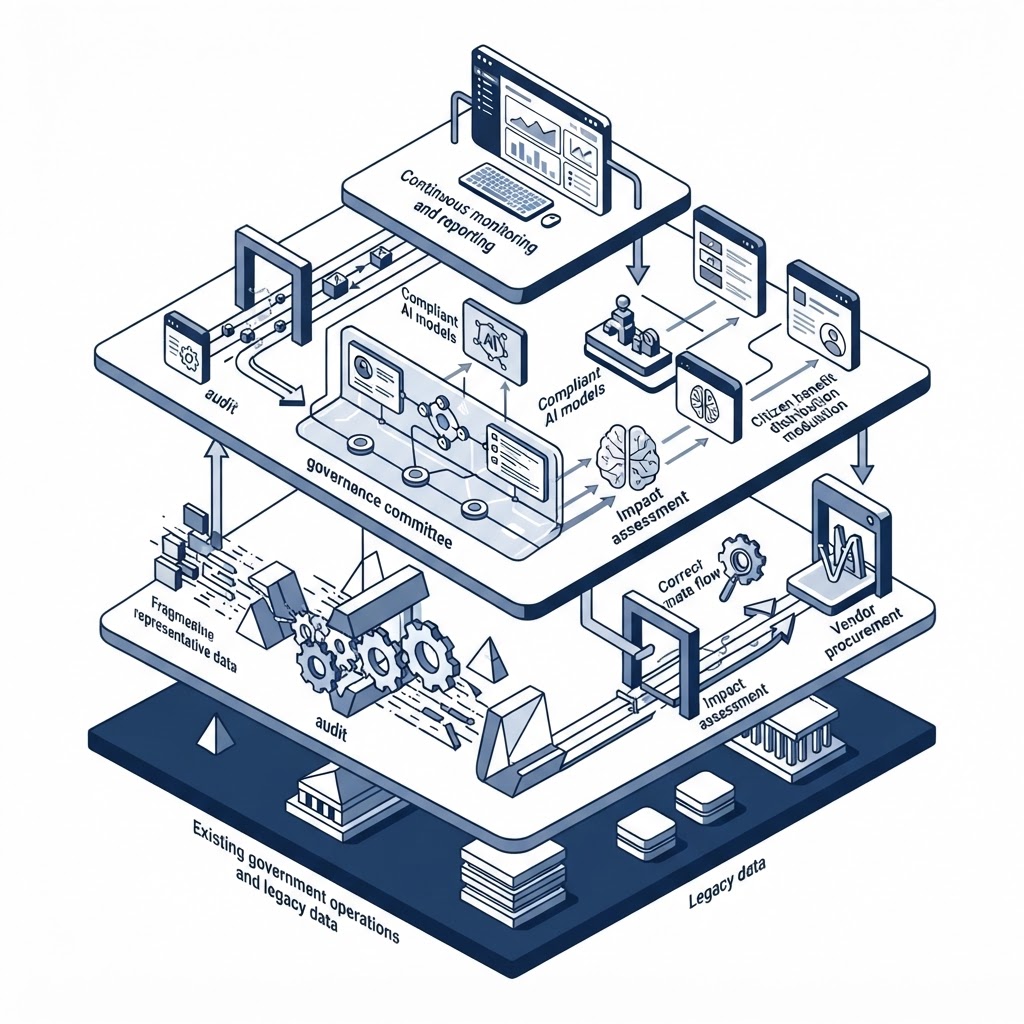
Agencies should begin by conducting a comprehensive inventory of all active and planned AI-driven systems. Once identified, audit these tools against the new federal Algorithmic Accountability Act requirements and state-specific laws like the Connecticut legislation. Establishing a cross-functional governance committee to oversee vendor procurement contracts and ensuring all AI models undergo rigorous, documented bias assessments is the most critical immediate action for compliance teams today.
Addressing Algorithmic Bias in Government Operations
Mitigating bias within public-facing algorithms has become a primary regulatory objective for state and local government leaders, as highlighted by the American Association for the Advancement of Science Artificial Intelligence: Responsible AI Use In Local and State Government | American Association for the Advancement of Science (AAAS). The challenge lies in the fact that legacy datasets often contain human biases that, if left unmanaged, become encoded into the decision-making logic of modern automated systems. To maintain public trust, agencies must prioritize diverse, representative datasets and implement continuous bias testing throughout the software development lifecycle.
This strategy is no longer optional; it is a core component of the evolving civil rights and fairness standards now governing the public sector. By integrating these processes into standard operating procedures, agencies demonstrate a commitment to equitable service delivery while reducing the risk of discriminatory outcomes. Experts suggest that agencies should treat AI fairness with the same rigor applied to existing data privacy regulations, such as those mandated by state-level privacy acts.
Establishing an AI governance charter that clearly defines acceptable use, performance metrics, and accountability structures is the most effective way to align current projects with the requirements of the Algorithmic Accountability Act.
Strategic Impacts for State and Municipal AI Procurement
State and local agencies face significant adjustments in how they approach AI procurement and vendor management in light of the new federal and state mandates. The primary change involves embedding algorithmic impact assessments directly into the Request for Proposal (RFP) process, ensuring that vendors provide transparency regarding their model training and bias mitigation results. Procurement offices must now demand clear explainability documentation, requiring vendors to prove how their systems arrive at specific conclusions—a standard now reinforced by the Algorithmic Accountability Act.
This shift prevents the introduction of opaque systems, often called 'black box' models, into government workflows. Furthermore, local governments should prepare to update their internal acceptable use policies, moving from general guidelines to specific, compliance-driven frameworks that align with current NIST AI RMF benchmarks. Training staff on these new requirements is equally vital, as employees managing AI tools must understand their role in maintaining ongoing monitoring and reporting.
By treating AI compliance as a mandatory component of the procurement lifecycle rather than an afterthought, agencies can effectively manage vendor risk, protect their reputation, and ensure they are utilizing technology that promotes, rather than hinders, equitable civic outcomes.
Executive Checklist for AI Governance
- →Establish a mandatory AI impact assessment protocol for all new public sector technology procurements. • Audit existing legacy algorithms against the new federal standards set by the Algorithmic Accountability Act. • Update vendor service-level agreements to require transparency reports on algorithmic bias and data diversity. • Appoint an internal AI compliance lead to monitor, report, and maintain documentation for state and federal regulators. • Implement routine, documented testing for fairness and equity in all algorithms that make resource allocation or civil rights-impacting decisions.
What are the potential regulatory consequences for failing to meet the new Algorithmic Accountability Act guidelines?
Organizations that fail to adhere to the federal Algorithmic Accountability Act may face formal federal investigations, fines, and legal action if their automated systems perpetuate illegal bias or discrimination. Beyond financial penalties, non-compliant agencies risk the court-ordered suspension of their AI services and significant erosion of public trust, potentially leading to the loss of government funding and the mandatory decommissioning of critical, non-compliant digital infrastructure and software tools.
The official recording of the Algorithmic Accountability Act signals a new, high-stakes era for technology in the public sector. By aligning procurement and internal operations with these stringent federal and state requirements, government leaders can ensure long-term stability and equitable service delivery. Compliance is now a continuous, active responsibility that must be embedded into the very foundation of agency digital strategy.
Sources
- CRI2026 - ALGORITHMIC ACCOUNTABILITY ACT - CRI-2026-ALGORITHMIC-ACCOUNTABILITY-ACT | Content Details | GovInfo
- 2026 AI Compliance: Upcoming Laws Every Organization ...
- Artificial Intelligence: Responsible AI Use In Local and State Government | American Association for the Advancement of Science (AAAS)
Tagged
About APEX AI Guardrails: We publish expert AI news and governance insights updated 4× daily. Our editorial team consists of retired government IT professionals, AI governance specialists, and compliance experts with deep experience in local government operations.
Related Articles
AI Governance
Mitigating AI Hallucination Risk in Government: New October 19 Federal Oversight Trends
October 19, 2026
AI Governance
Combating AI Deepfake Disinformation: How Government Agencies Can Restore Public Trust as of October 19, 2026
October 19, 2026
AI Governance
New Federal AI Systems Transparency Act Introduced Amid Growing Regulatory Pressure
October 19, 2026