
Mitigating AI Hallucination Risks: October 16 Update on SLED Governance Frameworks
As agencies face increased scrutiny, the approach to AI hallucination risk in government is shifting from simple testing to formal versioned governance. New mandates now require human verification for all high-stakes AI-generated outputs.
Published by
APEX AI Guardrails Editorial Team
October 16, 2026
Reading time
6
minutes
# Mitigating AI Hallucination Risks: October 16 Update on SLED Governance Frameworks
State and local government agencies are pivoting their strategy toward AI hallucination risk in government as legislative pressures mount to ensure algorithmic accountability. A senior immigration judge recently cautioned that over-reliance on automated tools creates dangerous gaps in administrative fairness, prompting a widespread reassessment of how public sector entities deploy LLMs. For IT and compliance leaders, this shift necessitates moving beyond pre-deployment sandboxes toward robust, versioned governance controls that mandate human-in-the-loop oversight.
How does the recent immigration judge's warning affect current agency AI procurement strategies?
The warning underscores that government reliance on AI-generated information in high-stakes decisions like asylum cases risks civil rights violations. Consequently, agencies must now prioritize procurement strategies that integrate rigorous human oversight and documented verification workflows. As noted in the 2026 Artificial Intelligence in Government Issue Memo, many legislatures are actively restricting the use of AI in high-stakes administrative areas to prevent automated errors from impacting citizen outcomes.
The Evolution of AI Hallucination Risk in Government Oversight
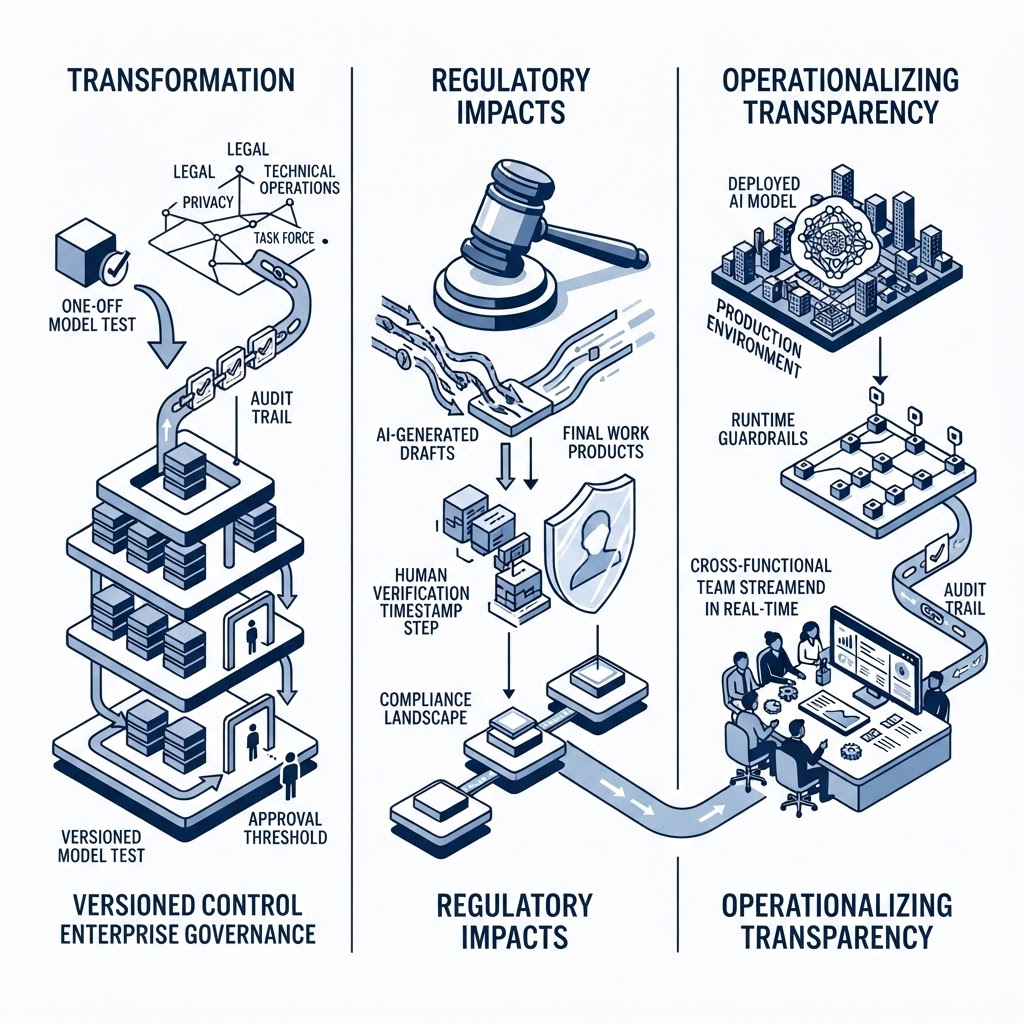
Hallucination detection is undergoing a critical transformation, transitioning from a one-off model test to a foundational component of enterprise governance. Modern strategies now treat hallucination scoring as a versioned control, ensuring that every model iteration undergoes documented validation before reaching production environments. According to experts studying hallucination detection tools, the responsibility for output quality can no longer rest solely with prompt engineers.
Instead, it must be integrated into broader organizational change management processes that span legal, privacy, and technical operations. By implementing these structured evaluation pipelines, agencies can better align their guardrails with the evolving technical capabilities of the models they procure. This shift is essential for maintaining compliance with emerging state-level mandates, which increasingly demand transparency regarding how AI systems reach specific conclusions.
Agencies that fail to document this oversight chain expose themselves to significant liability, especially when AI tools are utilized in public-facing services. As frameworks like the NIST AI RMF provide a blueprint for identifying systemic bias, the adoption of versioned scoring acts as a critical safeguard, ensuring that agencies maintain human accountability in an era of rapid AI integration across the public sector.
Why is versioned scoring considered a necessary component of modern AI governance?
Versioned scoring enables agencies to track how model reliability evolves, providing a verifiable audit trail for compliance. By treating scoring as a standard control, organizations can enforce strict approval thresholds, ensuring only stable models proceed to deployment. This methodology, discussed by industry experts regarding hallucination detection tools, shifts governance from a single static check to continuous monitoring of model performance over time.
Regulatory Impacts on SLED Algorithmic Accountability
Legislative bodies are responding to concerns about AI hallucination risk in government by introducing strict prohibitions on AI-generated final work products that lack human verification. The 2026 Artificial Intelligence in Government Issue Memo highlights that state legislators are rapidly drafting bills to limit AI autonomy in high-stakes sectors, specifically mentioning law enforcement and healthcare administration. These legislative efforts aim to protect citizen privacy and civil liberties while permitting the efficiency gains inherent in responsible AI usage.
For SLED agencies, this creates a new compliance landscape where "AI acceptable use policies" must be updated to include specific verification timestamps and identity-linked accountability for the final output. The recent warning from a senior immigration judge regarding AI-driven errors in asylum cases serves as a harbinger for broader regulatory enforcement Judge’s ‘AI hallucination’ warning raises questions over government AI governance. Agencies relying on automated decision-support systems must now prove that their "human-in-the-loop" processes are not merely perfunctory but are instead substantial checks against machine error.
This intersection of law and technology forces agencies to treat AI tools as intelligent assistants rather than autonomous decision-makers, keeping the final responsibility for administrative actions firmly with government personnel.
Operationalizing Transparency for Municipal and State AI Deployments
To effectively mitigate AI hallucination risk in government, departments must move toward runtime guardrails that capture performance data in real-time. This operational approach prevents the reliance on pre-deployment testing alone, which often fails to capture the nuanced drift of models in production environments. By establishing cross-functional task forces, municipalities can assess risks across disparate departments, from public safety to utility billing, ensuring that privacy and security are baked into every workflow.
Procurement teams must now require vendors to provide documentation on how their systems manage hallucination, including access to version-controlled evaluation metrics. Furthermore, training programs should be implemented to ensure staff understand the inherent limitations of generative AI, effectively demystifying the technology to prevent shadow AI usage. When agencies treat AI as a starting point, they establish a clear audit trail that preserves the integrity of administrative decisions, even when AI is used to synthesize large datasets.
This proactive stance on governance fosters public trust, proving that government agencies can balance technological innovation with the rigorous demands of civil service standards and regulatory compliance requirements.
Strategic Priorities for Compliance and IT Leadership
- →Establish versioned governance controls that track AI performance metrics across every system update. • Require vendors to disclose hallucination rate benchmarks as part of the procurement compliance process. • Mandate human verification steps for all AI-assisted final work products in high-stakes domains. • Deploy runtime guardrails that enable continuous monitoring of output quality beyond initial testing phases. • Update AI acceptable use policies to define clear boundaries between AI-generated drafts and final human-approved decisions.
What is the consequence for an agency found using AI in high-stakes decisions without documented human oversight?
Agencies face severe legal, ethical, and operational risks, including potential civil rights litigation and court-mandated reversals of administrative actions. The recent warning on government AI governance demonstrates that judges are increasingly skeptical of unverified AI claims. Without robust, documentable human-in-the-loop processes, agencies risk losing public trust and incurring significant costs associated with remediating automated errors in sensitive areas such as immigration, housing, or healthcare.
Addressing AI hallucination risk in government requires a fundamental pivot toward consistent, versioned governance rather than relying on one-off performance tests. As legislative mandates continue to tighten, public sector leaders must integrate rigorous oversight workflows into their daily operations. By prioritizing transparency and human verification today, agencies can successfully navigate the complexities of AI-driven administration while upholding their fundamental duty to the public.
Tagged
About APEX AI Guardrails: We publish expert AI news and governance insights updated 4× daily. Our editorial team consists of retired government IT professionals, AI governance specialists, and compliance experts with deep experience in local government operations.
Related Articles
AI Governance
Mitigating AI Hallucination Risk in Government: New October 19 Federal Oversight Trends
October 19, 2026
AI Governance
Combating AI Deepfake Disinformation: How Government Agencies Can Restore Public Trust as of October 19, 2026
October 19, 2026
AI Governance
New Federal AI Systems Transparency Act Introduced Amid Growing Regulatory Pressure
October 19, 2026