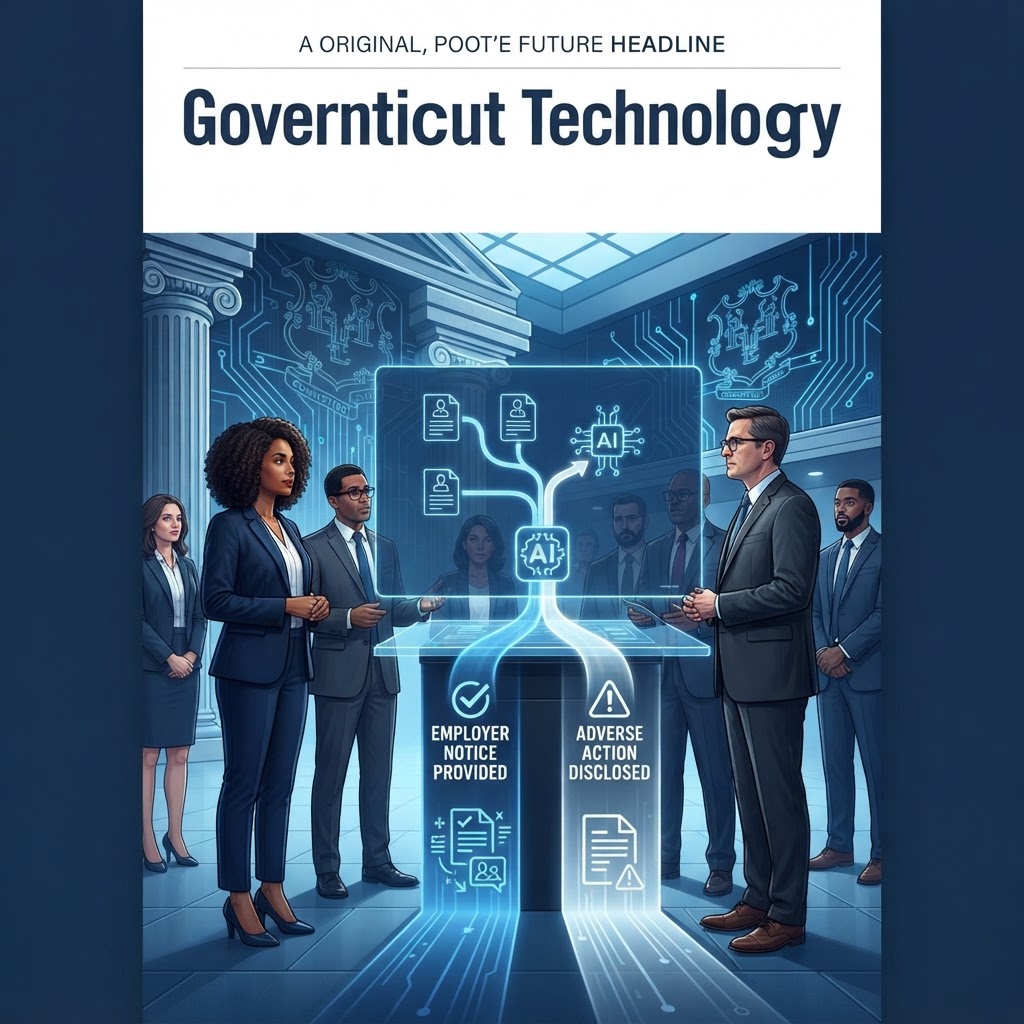
Connecticut CART Act Launches: New AI Transparency Mandates for Employment Decisions
The Connecticut Artificial Intelligence Responsibility and Transparency (CART) Act officially commences on October 1, 2026. This legislation introduces stringent disclosure requirements for AI-driven employment tools.
Published by
APEX AI Guardrails Editorial Team
October 2, 2026
Reading time
6
minutes
<h1>Connecticut CART Act Launches: New AI Transparency Mandates for Employment Decisions</h1><p>Effective October 1, 2026, the Connecticut Artificial Intelligence Responsibility and Transparency (CART) Act introduces a landmark regulatory framework mandating AI transparency in government decision making and private sector employment processes. This legislative shift arrives as state agencies and businesses must navigate the rollout of Connecticut Public Act 26-15, which necessitates explicit employer notifications regarding the utilization of automated tools in hiring. For government IT and compliance leaders, this represents a pivot toward mandatory accountability that could redefine procurement and internal AI usage policies.</p><p><b>How does the new Connecticut CART Act change the requirements for employers using automated hiring tools?</b> The CART Act, which began its phased implementation on October 1, 2026, requires organizations to provide clear, mandatory notice whenever an AI tool is utilized for employment-related decision making.
Crucially, the act clarifies that reliance on an AI system does not shield an employer from potential antidiscrimination liability, ensuring that human oversight remains the primary standard for legal compliance.</p><h2>The CART Act: A New Era for AI Transparency</h2><p>The introduction of the CART Act marks a definitive shift in how automated systems are scrutinized within the state, as detailed by recent legal updates. By mandating that employers disclose the use of artificial intelligence in recruitment, screening, and promotion, Connecticut is setting a precedent for algorithmic accountability. This is not merely an administrative checkbox; it is a structural requirement that forces organizations to integrate AI transparency in government decision making and workforce management.
Public sector agencies, which often serve as early adopters of innovative hiring technologies, must now reconcile their existing AI acceptable use policies with these new legal obligations. The legislation explicitly removes the 'AI-as-a-defense' loophole, reinforcing that the use of automated logic does not override existing state and federal antidiscrimination mandates. Consequently, agencies must ensure that every automated employment process is accompanied by a documented, transparent rationale that can withstand audit-level scrutiny.
This requires a shift from passive technology adoption to active, policy-driven oversight, ensuring that automated decision systems are aligned with the state's ethical and legal standards regarding equal opportunity and non-biased treatment.</p><p><b>What steps should compliance teams take to ensure alignment with the new Connecticut AI transparency requirements?</b> Organizations must first perform a comprehensive inventory of all AI tools used in employment processes. According to AIPolicyTracker, implementing standardized transparency documentation is the next critical step. Teams should establish a review cycle for 'System Cards,' conduct bias testing, and update employee notification protocols to meet the October 2026 regulatory timeline while aligning with broader frameworks like the NIST AI RMF.</p><h2>Global Shifts in AI Governance and Compliance</h2><p>As state-level mandates like the CART Act evolve, they are increasingly intersecting with international regulatory frameworks, such as the EU AI Act.
The release of the EU AI Act Article 50 Transparency Kit v6 provides a critical resource for organizations seeking to harmonize their internal controls with these rigorous global standards. By prioritizing 'System Cards' and safety documentation, this kit assists leaders in documenting how automated decisions are derived, which is essential for maintaining AI transparency in government decision making. This international shift toward documentation-heavy compliance is not an isolated trend; it represents a global move toward treating AI as a high-stakes infrastructure that requires constant validation.
For SLED agencies, the lesson is clear: localized compliance is becoming inseparable from global best practices. Agencies that adopt these standardized transparency frameworks today will find it significantly easier to pivot as more states adopt similar legislation, effectively future-proofing their AI governance charters and procurement workflows against emerging regulatory volatility in the coming fiscal years.</p><h2>Operational Readiness for Public Sector Agencies</h2><p>Public sector agencies must now prioritize the appointment of AI Nodal Officers to oversee the implementation of these new transparency mandates. These officers are tasked with interrogating vendor-provided AI tools, ensuring that procurement contracts include rigorous language regarding algorithmic accountability and explainability.
Utilizing new guidance from experts on interrogating AI regulations, agencies should establish a standardized approach to auditing automated systems before they enter production environments. This includes reviewing shadow AI risks and ensuring that all automated decision-making processes are captured in updated AI transparency reports. By establishing clear lines of accountability, agencies can mitigate the legal risks associated with 'black box' decision making while fostering public trust through transparent, evidence-based policy implementation.
Standardized reporting should cover the provenance of training data, the specific purpose of the AI tool, and the human oversight mechanisms in place to correct automated errors. This focus on procedural clarity is essential for any agency aiming to maintain compliance in a post-CART Act landscape.</p><h2>Actionable Steps for Governance Leaders</h2><ul>• Conduct an immediate audit of all AI tools currently utilized in the recruitment and hiring lifecycle to ensure compliance with the CART Act. <li>Establish a centralized AI governance charter that requires vendors to provide 'System Cards' for all automated decision-making platforms.</li> • Integrate the EU AI Act Article 50 transparency requirements into your procurement checklist for third-party AI software. <li>Designate an AI Nodal Officer within your agency to lead the cross-departmental coordination of AI transparency in government decision making.</li> • Implement regular bias audits for all AI tools, documenting the results to demonstrate consistent adherence to antidiscrimination statutes.</li></ul><p><b>What are the potential legal consequences for failing to provide adequate notice regarding AI use?</b> Failure to disclose the use of AI in employment decisions violates the CART Act and opens the organization to significant legal liability. As the law explicitly denies an 'AI-as-a-defense' strategy, agencies that cannot prove human oversight or provide transparent algorithmic justifications may face substantial penalties, discrimination litigation, and a total loss of public trust in their automated systems.</p><p>The integration of the CART Act into state governance marks a transformative moment for AI transparency in government decision making.
As compliance becomes a mandatory component of digital service delivery, leaders must prioritize transparent frameworks and rigorous vendor oversight. Now is the time for agencies to audit their internal policies and ensure they are prepared for this new era of algorithmic accountability.</p>
Tagged
About APEX AI Guardrails: We publish expert AI news and governance insights updated 4× daily. Our editorial team consists of retired government IT professionals, AI governance specialists, and compliance experts with deep experience in local government operations.
Related Articles
AI Governance
Mitigating AI Hallucination Risk in Government: New October 19 Federal Oversight Trends
October 19, 2026
AI Governance
Combating AI Deepfake Disinformation: How Government Agencies Can Restore Public Trust as of October 19, 2026
October 19, 2026
AI Governance
New Federal AI Systems Transparency Act Introduced Amid Growing Regulatory Pressure
October 19, 2026