
UK Launches National Centre for Information Defence to Combat AI Deepfake Disinformation Threats
Prime Minister Andy Burnham has unveiled a new UK-based agency dedicated to disrupting state-sponsored AI-enabled information warfare. This initiative marks a significant shift in how governments address the erosion of institutional trust caused by synthetic media.
Published by
APEX AI Guardrails Editorial Team
September 26, 2026
Reading time
6
minutes
# UK Launches National Centre for Information Defence to Combat AI Deepfake Disinformation Threats
The United Kingdom has officially established the National Centre for Information Defence to systematically identify and neutralize AI deepfake disinformation threats orchestrated by hostile state actors. Announced by Prime Minister Andy Burnham at the United Nations General Assembly, this agency aims to counter the industrial-scale proliferation of AI-falsified content that currently undermines global information integrity. For government IT and compliance leaders, this development signals an urgent need to integrate advanced threat detection frameworks into existing cybersecurity and AI governance operations.
How does the newly established National Centre for Information Defence identify and mitigate AI deepfake disinformation threats?
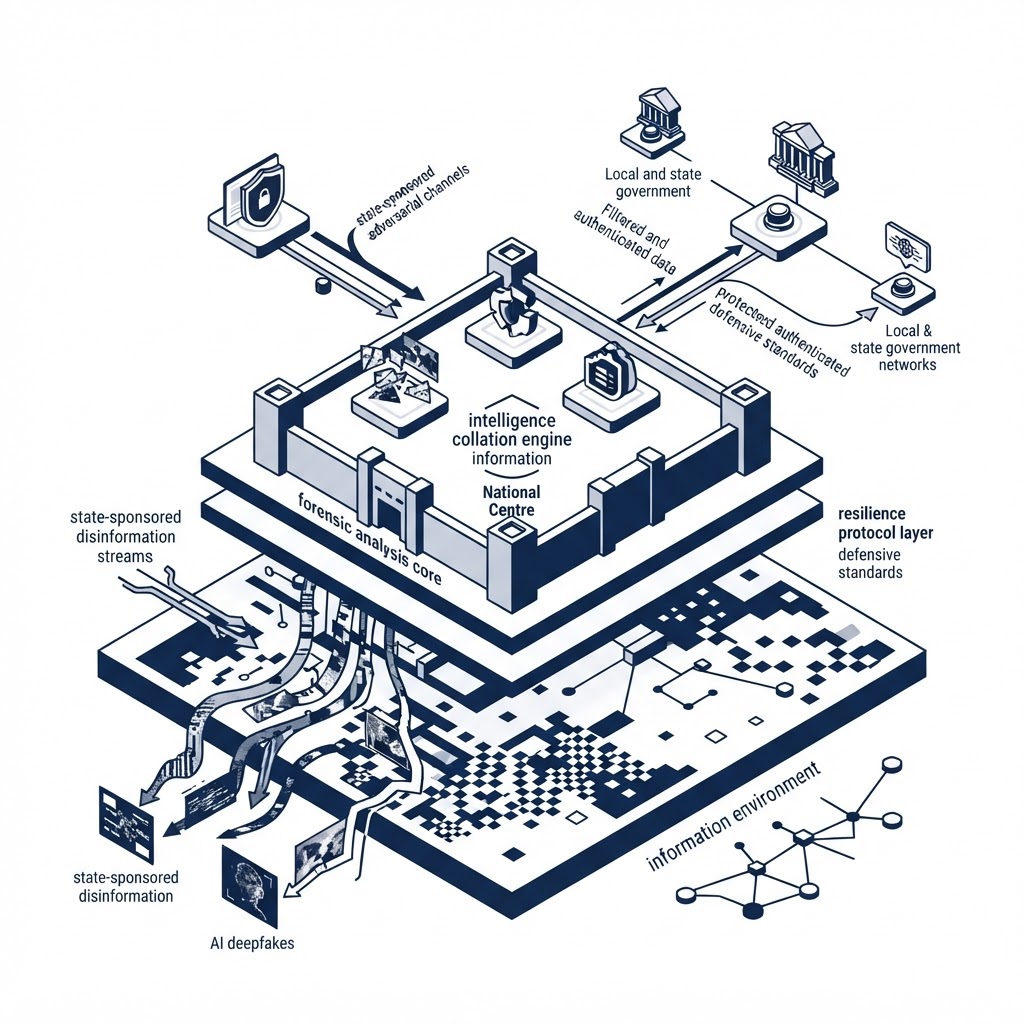
The National Centre for Information Defence functions as a cross-agency hub that utilizes advanced pattern recognition to detect, attribute, and disrupt state-sponsored information operations. By collaborating with intelligence services and social media platforms, the agency monitors for coordinated activity involving bots and AI-generated media. This approach aligns with broader international standards on information integrity, ensuring that governments can proactively address synthetic content before it impacts institutional stability or public confidence.
Strategic Mandate for the National Centre for Information Defence
The creation of the National Centre for Information Defence represents a hardening of the UK’s cyber-posture against what Prime Minister Andy Burnham describes as an industrial-scale assault on the information environment New UK agency to fight ‘information warfare’ from likes of Russia, Burnham tells UN. Operating at the intersection of intelligence gathering and digital forensic analysis, the new body is tasked with tracking the lifecycle of AI-falsified news articles and high-fidelity deepfakes. By centralizing these efforts, the government moves away from fragmented, reactive fact-checking towards a comprehensive model of information resilience.
The agency’s charter mandates close coordination with law enforcement and private sector digital platforms to disrupt the distribution channels used by foreign adversaries. This collaborative model is essential, as the rapid deployment of AI-enabled deception requires real-time data sharing between government agencies and the platforms that host public discourse. As organizations align with the NIST AI RMF, the Centre’s outputs are expected to provide critical threat intelligence that informs broader AI acceptable use policies.
By formalizing this response, the UK intends to preserve the integrity of its democratic institutions against sophisticated, state-led manipulation campaigns that prey upon public fears United Kingdom announces action on disinformation and global AI standards.
What are the required steps for agencies to align their procurement and AI policies with the new UK information defence standards?
Agencies should first conduct a comprehensive audit of current procurement processes to identify potential shadow AI vulnerabilities. Next, integrate CISA-aligned AI risk management protocols into vendor contracts to ensure AI transparency. Finally, implement continuous staff training on recognizing deepfakes, combined with robust AI data loss prevention (DLP) tools. These steps ensure that public sector entities remain resilient against the influence operations identified by the newly formed National Centre for Information Defence.
Managing the Escalation of AI-Driven Disinformation
The shift from organic misinformation to state-sponsored, AI-driven campaigns has created a persistent risk exposure for public sector organizations worldwide. Hostile actors now leverage large-scale automation to generate synthetic content that mimics government communications with high accuracy, making algorithmic accountability a top priority for IT leadership. According to recent disclosures at the UN, the scale of this synthetic activity is unprecedented, necessitating a shift in how democratic governments maintain transparency United Kingdom announces action on disinformation and global AI standards.
Compliance teams must now view AI deepfake disinformation threats as a Tier-1 operational risk, moving beyond standard cybersecurity to include influence operations in their governance charters. This requires a robust, proactive framework that can authenticate internal communications and verify the provenance of digital information before it reaches the public. By adopting the NIST AI RMF’s subcategories for system monitoring and incident response, agencies can better detect anomalous behavior that suggests a state-actor-driven infiltration of their information channels.
Maintaining public trust now hinges on an agency's ability to demonstrate that its digital environment is protected against the persistent, evolving deception techniques employed by foreign intelligence services New UK agency to fight ‘information warfare’ from likes of Russia, Burnham tells UN.
Operational Strategies for Local and State Government
State and municipal government agencies face unique challenges when defending against high-fidelity AI-generated deception that targets local democratic processes. Because these entities often operate with fewer dedicated cybersecurity resources than federal agencies, they are highly susceptible to campaigns that erode constituent trust. Procurement compliance is the first line of defense; agencies must mandate that AI vendors provide clear evidence of watermarking and provenance tracking within their AI governance charters.
Staff training should move beyond simple phishing simulations to include regular workshops on identifying synthetic media and the psychological triggers used in influence campaigns. Implementing an AI acceptable use policy is no longer optional; it is a critical instrument for limiting the spread of internal misinformation and ensuring that all synthetic content is clearly marked or restricted. Furthermore, local leaders should look to the federal government for updated CISA guidance on identifying, reporting, and mitigating the influence operations linked to the National Centre for Information Defence.
By closing these policy gaps, local governments can build a localized defense-in-depth strategy that prevents state-actor deception from compromising the integrity of municipal services or community engagement.
Essential Actions for Modern Information Integrity
- →Mandate rigorous vendor risk assessments to ensure all procured AI solutions include robust content provenance and watermarking features. • Align internal AI governance charters with current NIST AI RMF standards to improve organizational resilience against synthetic media. • Establish a rapid-response channel between local IT departments and the national authorities responsible for tracking state-sponsored information warfare. • Conduct mandatory employee training sessions focused specifically on the identification of AI-enabled deepfakes and manipulated synthetic news articles. • Update AI acceptable use policies to explicitly prohibit the use of unverified, AI-generated content in official public communications. • Invest in AI-driven DLP tools that can monitor organizational output for unauthorized synthetic modifications or falsified branding.
What are the primary consequences for government organizations that fail to account for the impact of AI deepfake disinformation threats?
Failure to mitigate these threats can result in the loss of public trust, the compromise of sensitive decision-making processes, and the unintentional dissemination of propaganda. Agencies may face regulatory scrutiny if they lack transparent AI governance frameworks, potentially leading to a breakdown in communication during emergencies. Furthermore, the inability to authenticate official information can result in widespread confusion and operational disruption when state actors successfully leverage AI to manipulate public perception.
The establishment of the National Centre for Information Defence underscores that the battle for information integrity is now a fundamental component of national security. Compliance leaders must shift their strategies to treat AI deepfake disinformation threats as a persistent, high-consequence risk to institutional legitimacy. Proactive governance and international cooperation remain our best defenses against the evolving tactics of state-sponsored information warfare.
Tagged
About APEX AI Guardrails: We publish expert AI news and governance insights updated 4× daily. Our editorial team consists of retired government IT professionals, AI governance specialists, and compliance experts with deep experience in local government operations.