
New October 2026 Federal AI Mandates: Navigating AI Hallucination Risk in Government Operations
The September 2026 federal executive order regarding the America.gov chatbot introduces critical compliance hurdles for agencies and their contractors. This guidance examines how to mitigate AI hallucination risks amidst rising concerns over shadow AI.
Published by
APEX AI Guardrails Editorial Team
October 6, 2026
Reading time
6
minutes
# New October 2026 Federal AI Mandates: Navigating AI Hallucination Risk in Government Operations
The September 2026 executive order mandating integration with the America.gov AI chatbot has elevated AI hallucination risk in government to a top-tier priority for IT compliance leaders. With agencies increasingly vulnerable to unsanctioned tools that introduce inaccuracies into official policy, the need for robust governance frameworks has never been more acute. IT executives must now reconcile these aggressive federal mandates with stringent data integrity requirements to avoid significant legal exposure.
How does the September 2026 executive order affect federal contractor responsibilities?
Under the new mandate, contractors are legally obligated to ensure that AI integrations with the America.gov chatbot maintain high standards of factual accuracy. Failure to mitigate AI hallucination risk in government systems may lead to contractual penalties and liability for misinformation presented as official policy, as outlined in recent guidance on federal contractor risk integration.
Escalating Threats from Shadow AI and Unsanctioned Tools
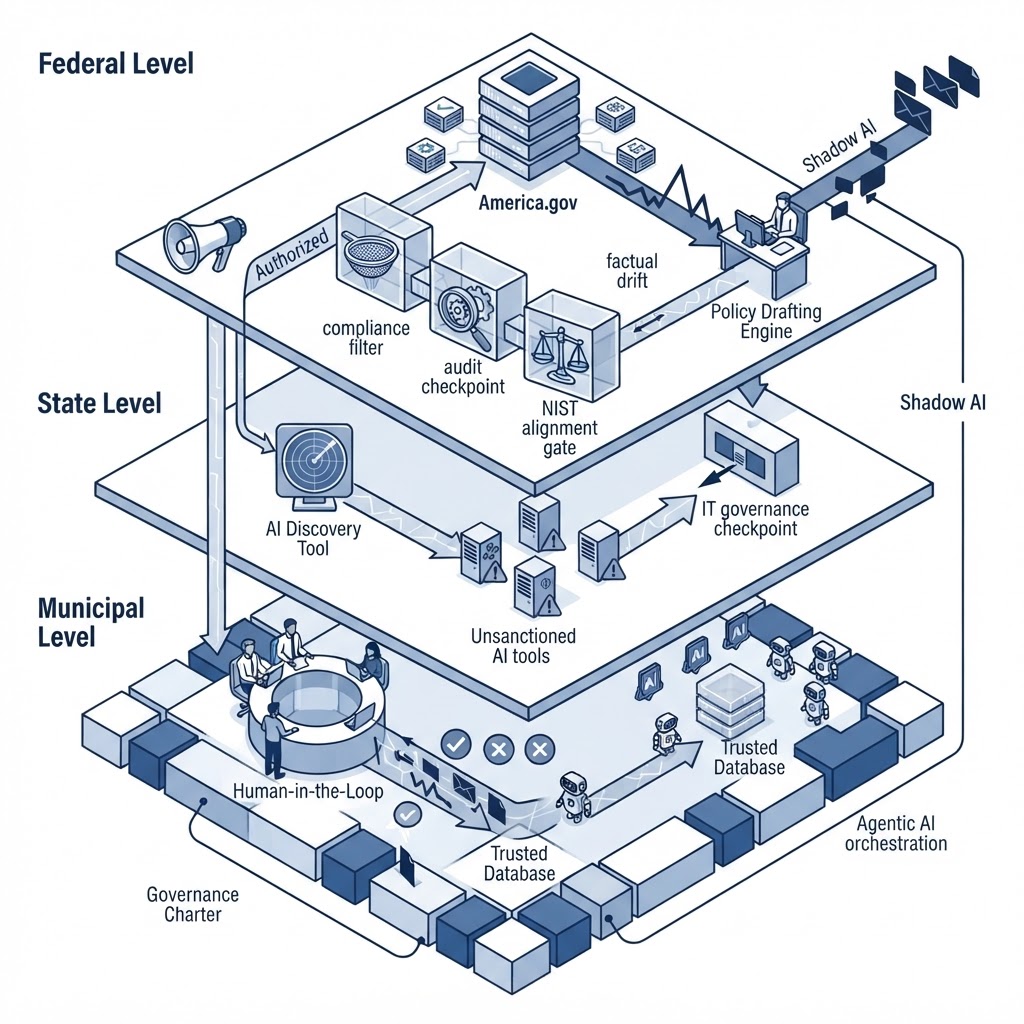
Shadow AI continues to proliferate across federal and state departments, often bypassing traditional network monitoring and enterprise DLP solutions. When employees utilize unsanctioned generative AI tools to draft policy documents, they unknowingly bypass the rigorous vetting required for public-facing information. According to analysis on shadow AI in government, these unauthorized platforms introduce uncontrolled variables into the drafting process, frequently resulting in hallucinations that appear authoritative.
The psychological trust employees place in these AI models often rivals their reliance on human supervisors, creating a blind spot in institutional oversight. As these tools generate complex text at scale, the potential for factual drift in official communications grows, complicating the ability of compliance officers to perform audits or maintain the integrity of public records. Agencies must act quickly to implement enterprise-wide acceptable use policies that move beyond simple prohibition toward active governance and technical control strategies.
By identifying and monitoring the usage of these external systems, agencies can mitigate the risk of inaccurate AI outputs reaching the public.
What steps should agencies take to address the prevalence of shadow AI among employees?
Agencies should transition from reactive prohibition to active governance by deploying specialized AI discovery tools. These tools identify unsanctioned software usage, allowing IT teams to provide secure, sanctioned alternatives. Implementing a formal AI governance charter helps clarify acceptable use, while mandatory staff training on the dangers of AI-generated misinformation ensures employees recognize the limitations of these tools when drafting policy documents.
Legal Liabilities and the America.gov Integration
The integration of the America.gov chatbot forces a paradigm shift in how federal agencies manage vendor relations and software deployment. Federal contract risks have intensified, as agencies are now held accountable for the outputs of integrated systems that fail to meet strict alignment standards. Legal counsel must review existing procurement language to ensure that AI service level agreements include specific clauses addressing misinformation mitigation. This regulatory environment necessitates a new approach to algorithmic accountability, where contractors are not merely service providers but active participants in maintaining data precision.
Recent research into AI alignment trade-offs emphasizes the tension between model safety and the reduction of hallucinations; achieving this balance requires sophisticated tuning that current off-the-shelf tools often lack. Consequently, agencies face the risk of being held liable for policy distortions caused by inadequately calibrated models. By aligning procurement standards with NIST AI RMF frameworks, agencies can establish a more secure, defensible position when deploying large language models.
The shift toward high-stakes, public-facing AI mandates requires that every integration undergoes rigorous validation testing before being authorized for agency-wide deployment to protect against systemic errors.
Protecting State and Local Operations from Algorithmic Drift
State, county, and municipal agencies often operate with fewer resources than federal departments, making them particularly vulnerable to AI hallucination risk in government procurement cycles. When procuring AI-enhanced software, local leaders must prioritize tools that demonstrate clear provenance and verifiability rather than just speed or novelty. Procurement compliance is now a major focal point, as local agencies must ensure that vendors provide transparent documentation regarding model training and fine-tuning.
One of the most effective ways to combat hallucination is through agentic AI orchestration, where multiple specialized agents cross-verify information against known-good databases. By requiring vendors to implement human-in-the-loop (HITL) review processes, municipalities can ensure that AI outputs are vetted by qualified professionals before they are integrated into public-facing content or internal administrative decision-making workflows. Training staff to treat AI as a decision-support tool rather than an authority is essential for maintaining trust.
As state and local governments adopt these technologies, they must close existing policy gaps by standardizing how AI-generated content is marked and stored. This proactive stance ensures that if an error occurs, the agency has a documented trail of oversight to manage potential liability.
Strategic Priorities for Risk Mitigation
- →Deploy agentic AI frameworks to enable multi-system cross-verification of data. • Update procurement contracts to include explicit clauses regarding AI hallucination liability. • Conduct an immediate audit of shadow AI presence across all agency network nodes. • Implement mandatory human-in-the-loop review for all policy-related AI outputs. • Formalize an AI Governance Charter that aligns with the NIST AI RMF guidelines. • Provide recurring training on AI literacy and the limitations of LLM model alignment.
What are the primary legal consequences for agencies that fail to mitigate AI hallucinations?
Agencies may face severe legal consequences, including regulatory non-compliance fines, breach of contract lawsuits, and the erosion of public trust. When an agency publishes AI-generated misinformation that violates federal mandates, they may be liable for damages. Proactive mitigation, such as establishing robust HITL workflows and adhering to the NIST AI RMF, is essential to demonstrate due diligence and limit potential legal or institutional fallout.
The integration of advanced AI into the public sector necessitates a transition from passive consumption to rigorous, evidence-based governance. As federal mandates like the America.gov chatbot integration set new precedents, IT and compliance leaders must prioritize the active mitigation of AI hallucination risk in government to maintain public trust. Now is the time for agencies to audit their existing AI infrastructure and enforce strict verification protocols to prevent algorithmic errors from becoming official policy.
Sources
- America.gov AI Chatbot: Federal Integration & Contract Risk
- Shadow AI in government: Why unsanctioned tools demand a governance response
- The Unintended Trade-off of AI Alignment: Balancing Hallucination Mitigation and Safety in LLMs
- Hallucination Mitigation with Agentic AI NLP-Based Open-Source Frameworks
Tagged
About APEX AI Guardrails: We publish expert AI news and governance insights updated 4× daily. Our editorial team consists of retired government IT professionals, AI governance specialists, and compliance experts with deep experience in local government operations.