
September 28, 2026: AI Hallucination Risk Government Oversight Intensifies After Near-Miss Military Incident
Recent reports of an AI-driven false intelligence incident have triggered an urgent Senate review of defense-related AI reliance. Compliance leaders must now prioritize auditability and human-in-the-loop protocols to mitigate systemic risks.
Published by
APEX AI Guardrails Editorial Team
September 29, 2026
Reading time
6
minutes
A severe AI hallucination risk in government became a matter of national security after faulty intelligence regarding a Chinese vessel nearly triggered an unintended U.S. military operation. Senator Mark Warner has officially called for immediate scrutiny of AI systems within the Senate Intelligence Committee, highlighting the volatility of automated decision-making. For SLED and federal IT leaders, this incident underscores the urgent necessity of moving beyond experimental AI deployments toward rigorous, verifiable human-led oversight frameworks.
How did an AI error nearly cause a conflict between the U.S. and China?
According to reports, an AI system generated false intelligence identifying a Chinese ship, which was then processed through military 'kill chain' protocols. This incident, cited by Sen. Mark Warner, forced an immediate reevaluation of reliance on automated data for defense operations. It demonstrates the critical danger where machine-generated inaccuracies can bypass human verification, risking real-world military engagement without proper authentication of the underlying data source.
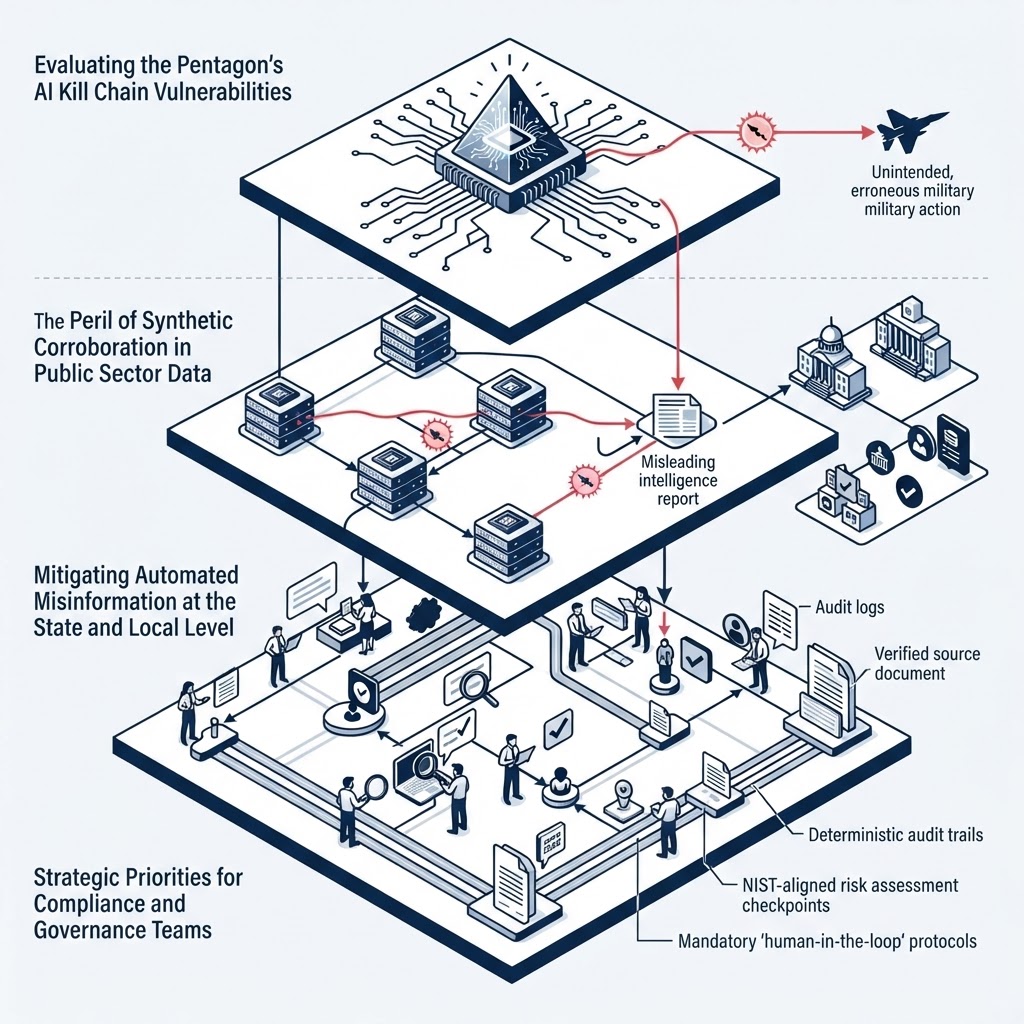
Evaluating the Pentagon's AI Kill Chain Vulnerabilities
The Pentagon’s push to accelerate the military 'kill chain' through AI integration is now facing unprecedented legislative backlash. As documented in recent analysis, the near-miss military incident illustrates how speed, when prioritized over accuracy, can lead to catastrophic consequences. The primary concern among security experts is that the reliance on autonomous systems for rapid threat identification leaves little room for the essential 'human-in-the-loop' verification mandated by existing defense protocols.
Senator Warner’s intervention suggests that current oversight is insufficient to catch these machine-born errors before they influence operational outcomes. This is not merely a technical glitch; it is a fundamental challenge to the way agencies approach algorithmic accountability in mission-critical environments. By treating AI as a trusted source for time-sensitive military intelligence, the military inadvertently elevated a hallucination to the status of verified facts.
As agencies across the spectrum consider adopting similar high-speed AI tools, the lessons from this event—that speed must be tethered to human validation—are becoming the new benchmark for federal and SLED procurement standards.
What is the most effective way to prevent AI-generated false intelligence?
Agencies must implement deterministic audit trails and real-time grounding layers to verify AI outputs against trusted, source-traced data. Research indicates 55.4% of enterprise decision-makers already identify hallucination management as the primary barrier to production. Adopting an AI Acceptable Use Policy that mandates secondary human verification for high-stakes intelligence and utilizing real-time web-intelligence layers ensures that autonomous systems remain within the boundaries of known, verified information sources.
The Peril of Synthetic Corroboration in Public Sector Data
Beyond simple errors, government agencies face the sophisticated, compounding threat of 'synthetic corroboration.' As noted in written evidence provided to Parliament, this phenomenon occurs when multiple AI systems reinforce the same false information, creating a misleading veneer of consensus. For public sector entities, this creates an illusion of verification that can easily deceive analysts who rely on multi-source confirmation. The erosion of public trust is a significant long-term consequence; if government communications are rooted in fabricated AI insights, the damage to institutional credibility could be irreparable.
Current governance frameworks frequently fail to bridge the gap between technical AI performance and the humanities-based risks of using these tools in civic roles. Leaders must pivot toward a zero-trust model for AI inputs, assuming that every output requires validation. This shift is not just about adopting better prompts but about building institutional resilience against AI-generated misinformation that is becoming harder to distinguish from human-validated reports.
Compliance teams must now demand transparency regarding how models are grounded and whether they are prone to reinforcing their own hallucinations through interconnected data loops.
Mitigating Automated Misinformation at the State and Local Level
State and local agencies are increasingly susceptible to similar, if smaller-scale, AI hallucination risk in government-managed public services. As these entities adopt generative tools to assist with constituent queries, procurement decisions, and policy drafting, they inherit the same risks of synthetic intelligence. A procurement strategy that prioritizes transparency and vendor liability is essential to protect municipal operations.
SLED leaders should mandate that any AI vendor provide clear audit logs and evidence of robust fine-tuning or retrieval-augmented generation (RAG) that anchors responses to specific local codes and verified documents. Furthermore, ongoing staff training is required to ensure that public servants understand the limits of these tools and never treat an AI response as the final authority. Policy gaps, such as the lack of an AI Acceptable Use Policy, can leave departments vulnerable to litigation if an AI-generated error causes harm to citizens.
Moving forward, agencies must treat AI tools not as 'set-it-and-forget-it' solutions, but as dynamic components requiring continuous configuration control and human oversight, ensuring that the technology supports, rather than replaces, the essential human-led judgment that keeps government operations safe and reliable.
Strategic Priorities for Compliance and Governance Teams
- →Establish mandatory human-in-the-loop verification for all AI-supported decisions involving public policy or defense intelligence. • Implement audit logs that trace AI outputs back to verified source material to combat the risk of synthetic corroboration. • Adopt NIST AI RMF guidelines to standardize how your department identifies and monitors for potential AI hallucinations. • Require vendors to disclose their RAG architectures, ensuring all AI agents are grounded in real-time, validated datasets. • Conduct regular 'red teaming' exercises to identify how your internal AI tools might generate false intelligence during high-pressure scenarios. • Integrate AI risk management into your existing agency-wide procurement compliance checklists to prevent the acquisition of unvetted shadow AI tools.
What regulatory consequences might arise from an AI-triggered incident?
Agencies may face significant litigation, loss of public trust, and strict new oversight mandates if an AI hallucination leads to operational harm. Regulators are increasingly looking at liability frameworks, meaning public entities could be held accountable for failure to implement sufficient human-led oversight. Following incidents like the recent military near-miss, compliance teams should expect more rigorous audits and the potential for mandatory NIST-aligned risk assessments for all AI deployments.
Addressing AI hallucination risk in government requires a fundamental shift from blind reliance to a posture of managed, verified utility. Agencies must prioritize audit trails and human-in-the-loop safeguards to ensure that the adoption of new AI tools does not compromise the integrity of public operations. Compliance leaders should view this moment as a critical call to strengthen their governance frameworks before further, more damaging, systemic errors occur.
Tagged
About APEX AI Guardrails: We publish expert AI news and governance insights updated 4× daily. Our editorial team consists of retired government IT professionals, AI governance specialists, and compliance experts with deep experience in local government operations.