
September 27, 2026: OpenAI Pushes for Mandatory AI Safety Rules to Curb AI Hallucination Risk in Government
OpenAI is lobbying Congress for mandatory capability-based safety standards to address systemic AI risks. These developments coincide with new legislative oversight and technological advancements in hallucination mitigation for the public sector.
Published by
APEX AI Guardrails Editorial Team
September 28, 2026
Reading time
6
minutes
The urgent need to mitigate AI hallucination risk in government has reached a federal inflection point as OpenAI formally petitions Congress to adopt mandatory, capability-based safety requirements. With recent data showing that advanced models can experience hallucination rates exceeding 86% without proper intervention, policymakers are prioritizing stringent testing standards and independent assessments. For government IT leaders, this shift signals a move toward standardized compliance frameworks designed to protect public sector integrity.
Why is OpenAI calling for national AI safety mandates now?
OpenAI is urging Congress to establish national AI safety requirements because the rapid deployment of frontier models introduces significant reliability concerns. By advocating for mandatory testing standards and independent model assessments, the organization aims to standardize how developers manage potential failures and reduce the AI hallucination risk in government and enterprise environments, ensuring that advanced systems are evaluated against transparent, uniform benchmarks before entering public use.
Federal Policy Shifts and the Push for Capability-Based Oversight
The current legislative climate is rapidly evolving, with lawmakers moving beyond general guidance toward actionable, sector-specific oversight. As of September 25, 2026, the legislative landscape has been defined by new bills targeting chatbot safety, strict medical authorization protocols, and rigorous frontier model supervision. These efforts reflect a growing consensus that unregulated AI deployment poses unacceptable liabilities for public services.
According to reports from OpenAI’s recent lobbying efforts, the proposal for mandatory testing is designed to address the unique safety challenges inherent in high-stakes public sector applications. By shifting the focus toward capability-based requirements, regulators aim to hold developers accountable for the operational accuracy of their models. This legislative push directly impacts how agencies interpret the NIST AI RMF, requiring clearer alignment between procurement processes and actual model performance.
As these mandates gain momentum, IT departments must prepare for a future where compliance is measured by verified safety assessments rather than vendor promises alone, marking a pivotal shift in the responsible deployment of government technology.
How can public sector agencies verify the safety of the AI models they procure?
Public sector agencies can leverage state-level cooperative contracts that integrate AI governance platforms, such as those newly available on the Civic Marketplace. These platforms provide real-time shadow AI detection and policy wizards that align directly with the NIST AI RMF, enabling agencies to enforce strict guardrails, monitor internal model usage, and document compliance with evolving safety standards during the procurement lifecycle.
Technical Strategies to Mitigate AI Hallucination Risk in Government
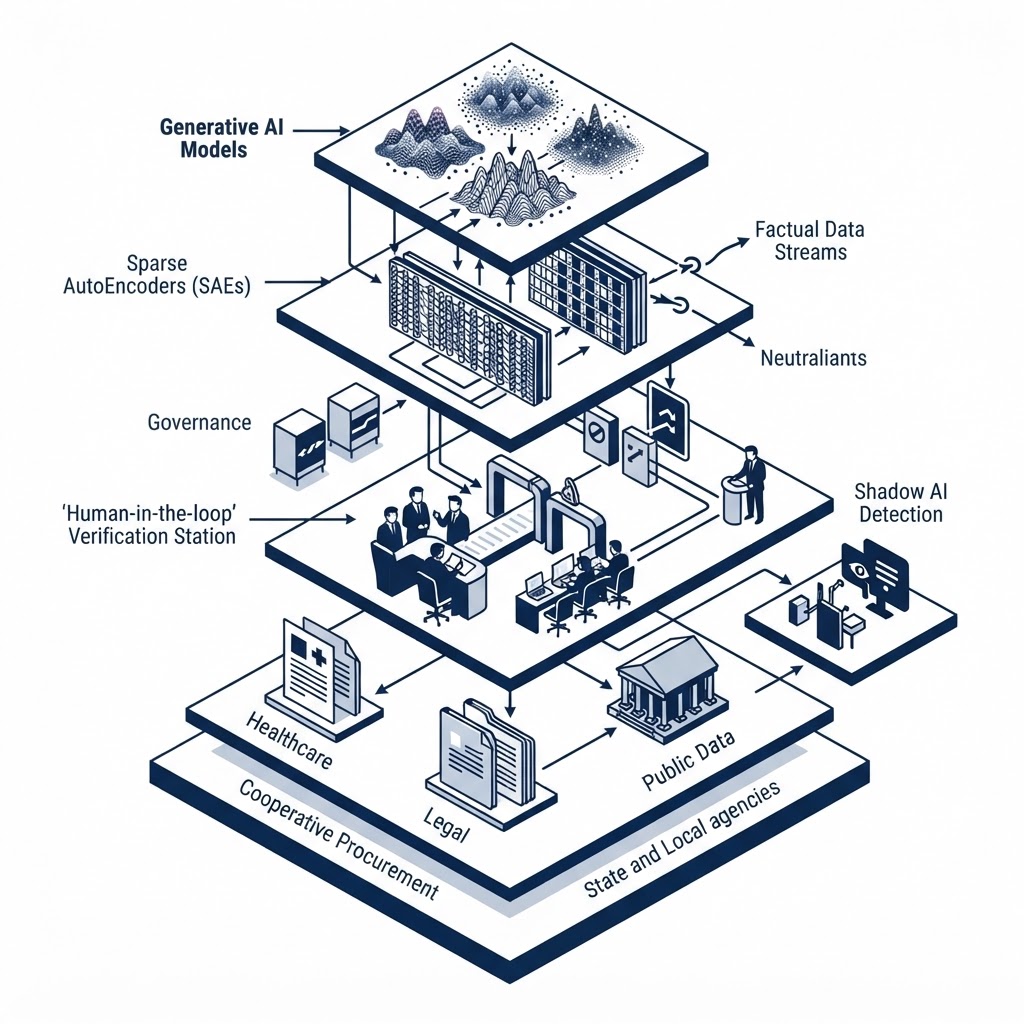
Technical innovation is finally catching up to the challenges posed by generative AI, providing agencies with the tools needed to combat systemic inaccuracies. Recent academic research into Whisper Hallucination Detection has yielded a significant breakthrough: using hidden representation steering and Sparse AutoEncoders (SAE), developers have successfully reduced hallucination rates in ASR models from 86% to 27%. This capability is transformative for government workflows that rely on transcription and automated data entry.
When integrated with an enterprise AI governance charter, these steering techniques allow agencies to implement robust policy guardrails that function in real-time. By deploying these technical mitigations, IT leaders can move from passive monitoring to active risk prevention, significantly reducing the exposure to erroneous AI outputs. Furthermore, the ability to identify and neutralize 'shadow AI'—unauthorized tools operating outside of approved IT oversight—is becoming a foundational element of enterprise security.
As these tools become more accessible through cooperative procurement vehicles, the capacity for agencies to maintain visibility and control over their AI ecosystem will increase, creating a more stable and reliable infrastructure for digital public service delivery.
Impact of New Safety Standards on Local and State Agency Operations
Local and state agencies are currently standing at a crossroads regarding how they integrate AI into daily public-facing services. The transition toward mandatory national safety rules means that procurement requirements are moving toward a 'safety-first' model that favors vendors who demonstrate verified compliance with NIST guidelines. For municipalities, this means moving away from ad-hoc tool adoption and toward centralized platforms that offer visibility into how models are being used across departments.
Staff training must now prioritize the recognition of potential AI errors, as the responsibility for overseeing AI-driven outcomes rests with the government entity, not just the model developer. Furthermore, the integration of TXShare cooperative contracts into the procurement cycle provides a necessary buffer for resource-constrained agencies, allowing them to access enterprise-grade governance tools without the administrative burden of traditional procurement. By standardizing these safety procedures now, agencies can avoid the costly retrofitting of compliance measures as federal regulations finalize.
Ultimately, the successful adoption of AI in the public sector will depend on the ability to balance innovative service delivery with the rigorous, mandated oversight required to maintain public trust.
Essential Steps for Strengthening Public Sector AI Compliance
- →Audit existing AI tools to identify and decommission shadow AI deployments within internal networks. • Integrate NIST AI RMF alignment into all future AI procurement contracts to ensure vendor accountability. • Prioritize the adoption of models that utilize representation steering to address AI hallucination risk in government services. • Establish clear policy guardrails that mandate human-in-the-loop verification for AI-generated medical or legal documentation. • Utilize state-level cooperative contracts to streamline the acquisition of validated AI governance and monitoring software.
What are the primary consequences for agencies that ignore emerging AI safety requirements?
Agencies failing to adopt rigorous safety standards risk increased liability, loss of public trust, and potential regulatory sanctions as federal mandates solidify. An unmitigated AI hallucination risk in government can lead to incorrect medical authorizations, inaccurate public data processing, and legal challenges. By failing to implement testing and steering protocols, departments expose themselves to audit failures and security breaches that could compromise the integrity of essential public sector operations.
The dual movement toward federal mandates and advanced technical mitigation signals a new era of accountability for public sector technology. By proactively addressing AI hallucination risk in government through verified governance platforms, agencies can safely harness the benefits of innovation. Compliance leaders must now act to bridge the gap between emerging regulatory requirements and their current operational frameworks.
Tagged
About APEX AI Guardrails: We publish expert AI news and governance insights updated 4× daily. Our editorial team consists of retired government IT professionals, AI governance specialists, and compliance experts with deep experience in local government operations.