
October 8: Managing AI Hallucination Risk in Government Systems
Public sector agencies face mounting legal and operational challenges as AI hallucinations threaten data integrity and public trust. This guide outlines essential strategies for mitigating these risks while ensuring compliance with established regulatory frameworks.
Published by
APEX AI Guardrails Editorial Team
October 8, 2026
Reading time
6
minutes
Addressing AI hallucination risk in government is now a top-tier mandate as agencies deploy LLMs that can generate plausible but false information. Recent reports confirm over 220 documented legal incidents involving AI-generated inaccuracies, which could lead to severe operational disruptions or security breaches. For SLED IT and compliance leaders, mastering these risks is critical to protecting sensitive citizen data while maintaining public trust.
How do AI hallucinations specifically impact legal liability for state and local government agencies?
AI hallucinations introduce significant legal liability when models fabricate case law, policy summaries, or citations. According to recent industry analysis, these failures can lead to operational disruption and systemic security breaches. Agencies failing to implement proper verification controls risk violating regulatory requirements like FERPA and HIPAA, which mandate strict accuracy and data protection standards when handling sensitive student and citizen information.
Understanding the Scope of AI Hallucination Risk in Government
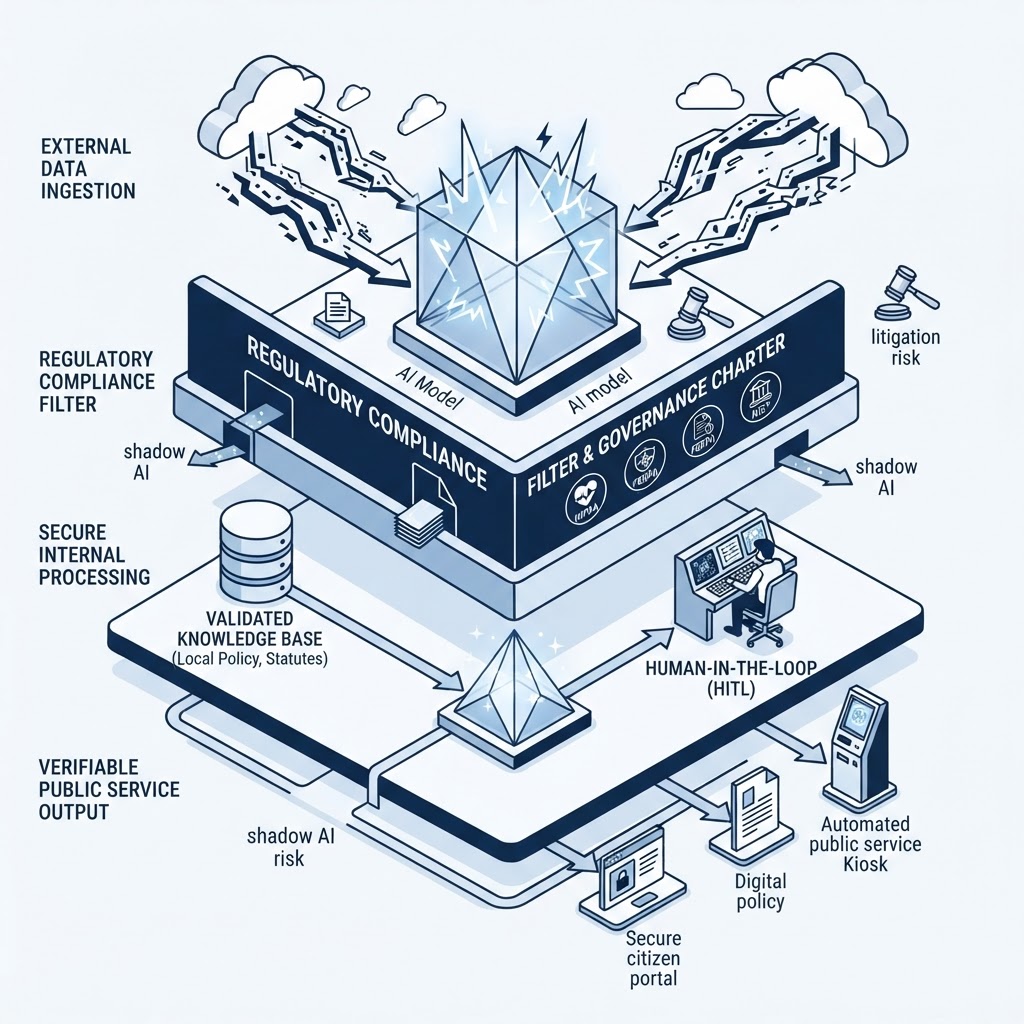
The threat of AI hallucination risk in government is multifaceted, primarily occurring when large language models (LLMs) ingest nuanced, domain-specific public sector data that lies outside their primary training corpus. When an LLM lacks sufficient grounding in local policy or state-specific statutes, it may fabricate responses that appear authoritative but are factually incorrect. This phenomenon poses a direct challenge to agencies governed by rigid security mandates such as FERPA and HIPAA, where accuracy is not merely an operational goal but a legal requirement SLED.
Furthermore, the lack of transparency in how these models synthesize information can lead to 'shadow AI' deployments where staff use generative tools without proper IT oversight. As highlighted in current research, AI hallucinations could cause nightmares for your business, specifically regarding the 220-plus documented legal incidents where false content led to costly repercussions. To combat this, agencies must prioritize database-grounded context injection, ensuring the AI relies exclusively on validated, secure internal knowledge bases rather than unverified training data.
This shift towards responsible AI requires a fundamental transformation in how public sector entities handle algorithmic accountability and model transparency.
What steps should a municipality take to verify AI outputs for public sector compliance?
Municipalities should implement a multi-layered verification stack featuring human-in-the-loop (HITL) workflows for all automated decisions. This includes mandating database-grounded context injection to restrict AI responses to verified source material. Furthermore, agencies must adopt unified data governance platforms to prepare complex data estates. By aligning AI outputs with existing regulatory frameworks like FERPA or HIPAA, agencies establish a verifiable audit trail for every AI-generated decision.
Strategic Governance and Regulatory Alignment
Establishing robust AI governance is essential for SLED agencies preparing for the rapid rise of autonomous agents. The AI Governance World Conference 2026 taking place October 12-14 in Las Vegas will focus heavily on these control systems, emphasizing the need for standardized safety protocols across all government sectors. As agencies integrate these autonomous agents, they must align their deployment strategies with the NIST AI RMF to ensure algorithmic accountability.
The risk exposure is significant; unauthorized or poorly governed AI systems can inadvertently leak sensitive citizen data or produce biased, legally non-compliant policy guidance. Compliance leaders should view this period of rapid innovation as a call to finalize their AI acceptable use policies. By centering governance on centralized control systems, agencies can mitigate the risk of fragmented, non-compliant AI adoption.
This proactive stance not only protects the agency from litigation but also ensures that the integration of AI tools supports, rather than undermines, the public service mission. Consistent monitoring and iterative risk assessments remain the most effective ways to manage the evolving threat landscape in this high-stakes environment.
Essential Steps for Strengthening Agency-Wide AI Security
State and local agencies must immediately prioritize procurement compliance when vetting new AI vendors to ensure their tools include native hallucination mitigation features. Effective oversight begins by closing existing policy gaps through a comprehensive AI governance charter that explicitly defines acceptable use and identifies high-risk workflows requiring manual human intervention. Training staff to recognize the warning signs of AI-generated fabrications is a non-negotiable step in maintaining operational integrity.
Furthermore, IT departments must conduct regular audits of AI DLP (Data Loss Prevention) capabilities to prevent sensitive information from being processed by unvetted third-party tools. Agencies should also look to leverage standardized frameworks discussed at industry events like the 2026 AI Governance World Conference to ensure their internal protocols mirror national best practices. By focusing on data provenance and strict access controls, agencies can build a resilient digital infrastructure that benefits from AI innovation while shielding the organization from potential legal and reputational damage.
Consistent communication between legal, IT, and administrative leadership is the final pillar required to sustain a safe and compliant AI integration strategy throughout the coming fiscal year.
Actionable Takeaways for Compliance Teams
- →Implement database-grounded context injection to force models to utilize only trusted internal data sources. • Establish mandatory human-in-the-loop verification processes for any AI-assisted decision that affects citizen services. • Update procurement policies to require evidence of hallucination mitigation testing from all AI technology vendors. • Align AI deployment strategies with existing HIPAA and FERPA requirements to ensure continuous regulatory compliance. • Participate in industry forums like the AI Governance World Conference to adopt emerging standards for autonomous agent security.
What are the long-term consequences of failing to address AI hallucination risk in public sector data?
Failure to address AI hallucination risk exposes agencies to severe legal liability, permanent loss of public trust, and potential regulatory sanctions for data privacy violations. When false information is used in official policy or decision-making, it can lead to costly litigation, operational paralysis, and mandatory investigations by oversight bodies. Proactive mitigation is essential to avoid the catastrophic impact of AI-generated inaccuracies on sensitive citizen and student records.
Managing AI hallucination risk in government is an ongoing obligation that requires constant vigilance and a commitment to rigorous, evidence-based oversight. As agencies refine their integration strategies, the focus must shift toward creating a culture of responsible AI use that prioritizes data integrity and compliance. IT and compliance leaders who act now to implement these governance frameworks will be the best positioned to safely leverage AI for the public good.
Tagged
About APEX AI Guardrails: We publish expert AI news and governance insights updated 4× daily. Our editorial team consists of retired government IT professionals, AI governance specialists, and compliance experts with deep experience in local government operations.