
NYC Council Advances Landmark Algorithmic Accountability Bills Targeting Bias and Safety as of September 27, 2026
The New York City Council is spearheading municipal AI oversight with upcoming legislation requiring third-party bias and security validation for automated tools. This shift signals a new era of strict algorithmic accountability for government agencies and their private-sector technology partners.
Published by
APEX AI Guardrails Editorial Team
September 27, 2026
Reading time
6
minutes
The New York City Council is set to hear pivotal legislation on October 5, 2026, aimed at establishing rigorous algorithmic accountability for AI systems deployed within municipal functions. This move toward municipal-level AI oversight fills a significant gap left by the absence of federal safety legislation. For government IT and compliance leaders, these proposed requirements necessitate an immediate re-evaluation of current AI procurement, validation, and security protocols to align with incoming local mandates.
What does the proposed New York City legislation require from companies using AI in the public sector?
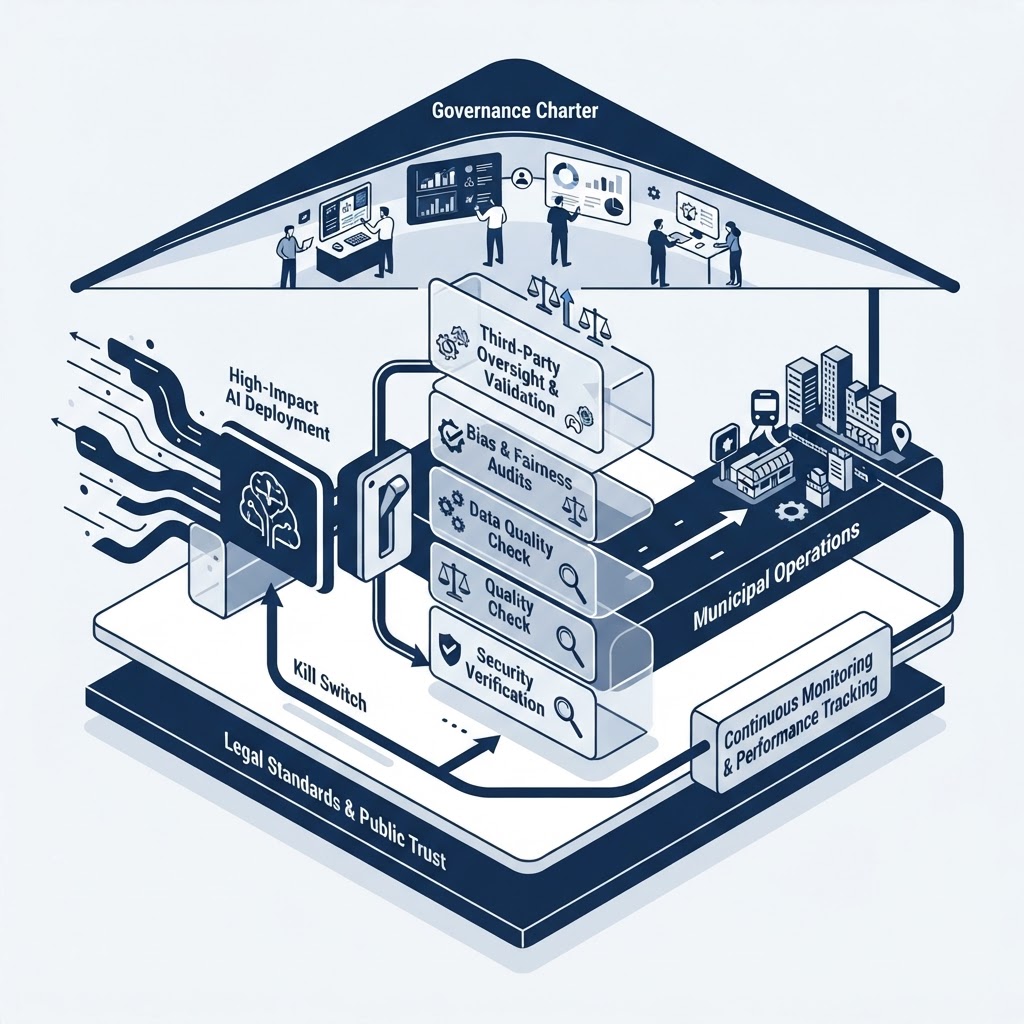
The proposed NYC bills mandate that AI systems used in public sectors undergo mandatory third-party validation to assess bias, data quality, and security standards. Additionally, the legislation seeks to introduce specific requirements for kill-switch capabilities and enhanced whistleblower protections. These measures are designed to ensure that automated decision-making tools remain transparent, safe, and accountable to the public they serve, directly addressing concerns regarding algorithmic bias and system reliability.
Driving Innovation Through Localized Algorithmic Accountability Mandates
As Washington continues to deliberate on broad national AI frameworks, New York City is taking definitive action to address the risks inherent in automated public tools. The hearing scheduled for October 5, 2026, represents a critical shift, as city leaders propose a structure that mandates third-party oversight for high-impact AI deployments. According to recent reporting, these legislative efforts emphasize the necessity of verifying data quality and security before tools are integrated into municipal operations.
Central to these proposals is the requirement for a 'kill switch,' a technical feature intended to halt autonomous processes immediately if a system exhibits erratic or harmful behavior. Furthermore, the council is championing whistleblower protections, ensuring that individuals who identify failures in these AI systems can report concerns without fear of retaliation. This development signals a departure from self-regulation, moving toward a model where outside validation for AI systems becomes a standard prerequisite for public procurement.
Agencies must now prepare for a landscape where transparency is not just an ideal but a documented, audited requirement that must be demonstrated at every stage of the software development lifecycle to maintain operational legitimacy and public trust.
How can agencies transition from periodic testing to a continuous monitoring framework for AI compliance?
Agencies should move from periodic audits to a continuous monitoring framework by integrating automated logging and real-time performance tracking into their AI lifecycle management. By aligning with NIST AI RMF guidelines, teams can deploy persistent dashboards that track model drift, detect anomalies, and flag potential biases as data inputs change. Establishing a dedicated AI governance charter ensures that monitoring isn't a one-time check but a permanent part of the operational security posture.
Aligning Judicial Standards with Algorithmic Accountability Expectations
The legal landscape for AI deployment is intensifying as courts increase their scrutiny of AI-assisted litigation and administrative decision-making. As outlined in the Employer Checklist for September 2026, there is a significant judicial push to define the boundaries of confidentiality and privilege when AI tools are involved in legal workflows. Organizations that fail to maintain a strict wall between AI-generated output and human-led analysis risk compromising their legal standing and work product.
Moreover, independent bias audits are no longer optional best practices but core operational requirements for any high-risk AI deployment. Industry leaders are moving away from surface-level risk assessments toward in-depth audits that verify the integrity of underlying training datasets. This focus on algorithmic bias and compliance extends to the necessity of auditing for civil rights compliance, ensuring that automated hiring or resource allocation tools do not inadvertently discriminate against protected classes.
For legal and IT departments, the directive is clear: maintain granular documentation of all AI-driven processes. Failure to produce evidence of rigorous auditing can now serve as a primary vulnerability in litigation, making proactive governance a financial and operational necessity for every state and municipal entity.
Strategies for State and Local Agencies Facing New Oversight Standards
State and local governments must urgently adapt their procurement pipelines to satisfy the demands of evolving algorithmic accountability standards. The primary challenge involves closing the gap between off-the-shelf AI capabilities and the robust governance requirements now being piloted in major metropolitan areas. Agencies should start by revising their vendor risk assessment forms to explicitly request third-party audit reports and evidence of bias-mitigation testing.
Integration of human-in-the-loop oversight is critical here; no AI system should be granted autonomous decision-making power in public-facing services without a clear escalation path to human oversight. Procurement officers must insist on transparency documentation from vendors, ensuring that algorithmic logic is explainable and subject to audit. Staff training should be modernized to include not only technical proficiency but also awareness of the ethical implications of AI use.
By fostering an organizational culture centered on responsible AI deployment, agencies can proactively mitigate risks associated with shadow AI and ensure that all new technologies comply with emerging civic safety benchmarks. Ultimately, the goal is to build an environment where algorithmic tools support public services rather than creating new liabilities through opaque or biased decision-making processes.
Navigating the Future of Ethical AI Deployment
- →Implement mandatory third-party audits for all high-impact AI systems to ensure compliance with emerging safety standards. • Establish a formal 'kill switch' protocol that allows administrators to immediately disable malfunctioning or biased automated tools. • Transition to a continuous monitoring framework to track model drift and bias in real-time, moving beyond static periodic reviews. • Strengthen procurement compliance by requiring vendors to submit granular documentation on data lineage and algorithmic logic during the onboarding process. • Develop a robust internal AI governance charter that defines the roles and responsibilities of human-in-the-loop oversight for automated decision-making.
What are the primary legal consequences for failing to demonstrate algorithmic accountability in public AI projects?
Failing to demonstrate algorithmic accountability can lead to severe legal and financial consequences, including civil rights lawsuits, regulatory fines, and the loss of public trust. When an AI system exhibits bias, the burden of proof often shifts to the agency to demonstrate that rigorous, independent auditing was performed. Courts may invalidate agency decisions made by biased systems, necessitating expensive manual re-processing and potentially resulting in court-mandated federal oversight of digital initiatives.
The push toward strict algorithmic accountability in cities like New York underscores a permanent shift in how government entities must manage, validate, and monitor artificial intelligence. As legislative frameworks begin to solidify, compliance leaders must prioritize transparency and human-centric oversight to maintain the integrity of public digital services. Staying ahead of these standards is not merely a legal imperative but a fundamental prerequisite for the ethical advancement of government technology.
Tagged
About APEX AI Guardrails: We publish expert AI news and governance insights updated 4× daily. Our editorial team consists of retired government IT professionals, AI governance specialists, and compliance experts with deep experience in local government operations.