
NIST AI Risk Management Framework: New August 2026 Strategic Guidance for SLED Agencies
As of August 2026, over 55% of government agencies have adopted AI, yet a significant policy gap remains. This report explores how the NIST AI Risk Management Framework is being utilized to secure critical infrastructure and manage generative AI risks.
Published by
APEX AI Guardrails Editorial Team
August 17, 2026
Reading time
6
minutes
As of August 17, 2026, the NIST AI Risk Management Framework has transitioned from a voluntary set of guidelines into the definitive blueprint for state and local government AI adoption and regulatory compliance. Recent data indicates that while 55.7% of government organizations have integrated AI into their daily operations, only 42.9% possess formal AI policies, creating a significant regulatory and safety exposure gap. For public sector IT leaders and compliance officers, implementing this framework is now essential to ensuring algorithmic accountability and mitigating the specific risks associated with rapid generative AI deployment in municipal environments.
How has the NIST AI Risk Management Framework changed for financial and critical infrastructure sectors in August 2026?
In August 2026, the NIST AI Risk Management Framework evolved into a foundational regulatory layer, with a new concept note released specifically for Trustworthy AI in Critical Infrastructure to guide operators of high-stakes systems. According to NIST AI RMF Explained, the framework now serves as the base for sector-specific guidance, including mandatory compliance standards for financial institutions, shifting focus from static policy to active, production-level risk management.
Bridging the Governance Gap in the 2026 NIST AI Risk Management Framework Landscape
The disparity between technological adoption and institutional oversight has reached a critical juncture in the third quarter of 2026. While over 55% of state and local agencies have deployed machine learning models, the lack of formal governance frameworks leaves these entities vulnerable to legal challenges and technical failures. According to researchers at Granicus, 65% of SLED leaders identify internal workflow complexities as the primary barrier to establishing a functional NIST AI Risk Management Framework implementation.
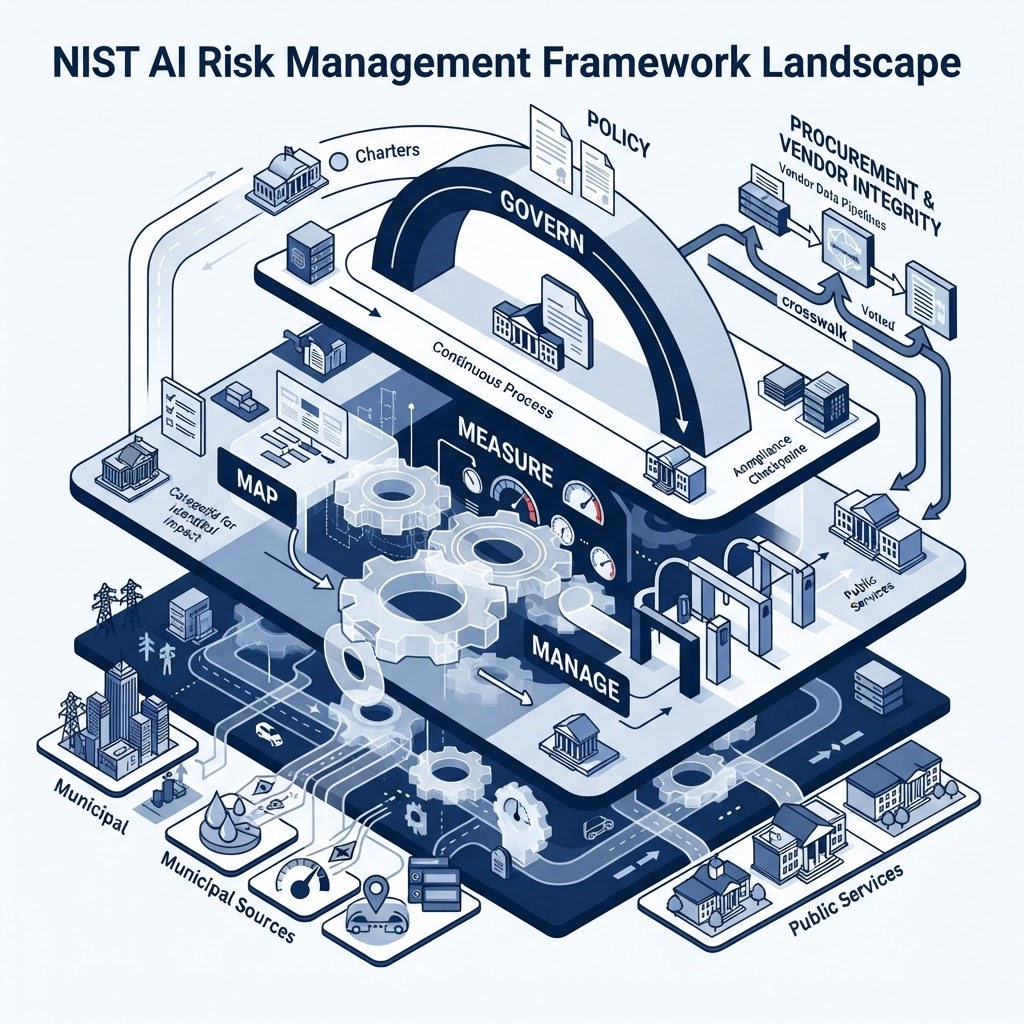
This oversight gap is particularly pronounced in smaller municipalities where technical debt often precedes policy development. To address this, agencies are increasingly adopting the 'Govern' function of the NIST RMF not as a one-time setup, but as a continuous institutional process. By establishing an AI governance charter and acceptable use policies, agencies are beginning to move toward a model of responsible AI that prioritizes transparency.
The goal for the remainder of 2026 is to ensure that every AI-enabled public service is backed by a risk-informed strategy that accounts for both intended impacts and unintended consequences.
What steps should a county IT department take to align with the latest NIST AI RMF 1.0 implementation reports?
To align with August 2026 implementation reports, county IT departments should utilize the NIST AI RMF 1.0 to transition from governance-on-paper to active risk management. According to VisioneerIT, agencies must first 'Map' specific AI impacts on public services, then 'Measure' those risks through quantitative monitoring, and finally 'Manage' them by deploying automated incident response protocols and bias-reduction tools within their production environments.
Securing Critical Infrastructure with the NIST AI Risk Management Framework
A significant shift in the 2026 landscape is the NIST release of a specialized concept note for an AI RMF Profile on Trustworthy AI in Critical Infrastructure. This guidance is designed to help operators of energy grids, water systems, and transportation networks manage the unique failure modes of AI-enabled capabilities. As highlighted by the NIST Official Site, this profile ensures that the core functions of Map, Measure, and Manage are applied with a focus on safety-critical outcomes.
Furthermore, the framework has become the 'base layer' for other federal and state regulators, who are now drafting mandatory compliance standards for the energy and financial sectors based on these NIST principles. The focus is no longer just on technical accuracy, but on the socio-technical aspects of AI, including human-in-the-loop requirements for high-risk decision-making. Agencies are finding that by aligning with these NIST standards, they can more easily achieve global interoperability with international benchmarks like ISO 42001.
This alignment is crucial for SLED agencies that rely on diverse software ecosystems and need to maintain high levels of algorithmic accountability across various public-facing applications.
Navigating Procurement and Vendor Integrity for Municipal AI Systems
In late 2026, the focus of AI risk management has expanded heavily into the supply chain, requiring agencies to vet the transparency and model lineage of external vendors. The integration of the Generative AI Profile, known as NIST AI 600-1, is now a standard requirement for SLED agencies utilizing large language models (LLMs) for constituent services. This profile helps mitigate risks such as prompt injection, data leakage, and training data contamination.
According to IS Partners LLC, the 2026 updates place a high priority on managing third-party dependencies, ensuring that agencies are not unknowingly assuming the risks of their software providers. Digital transformation officers are now utilizing 'crosswalks' to map NIST outcomes to international standards, simplifying the procurement process. By demanding NIST-aligned risk reports from vendors, municipalities can prevent 'shadow AI' from entering their networks.
This proactive stance on procurement compliance is essential for maintaining data privacy and preventing unauthorized data exposure, especially when public-sector datasets are used to fine-tune third-party models.
Priority Actions for SLED Digital Transformation Officers
- →Establish the 'Govern' function as a perpetual lifecycle rather than a static document to ensure ongoing maturity-driven assessments. • Integrate the NIST AI 600-1 Generative AI Profile to specifically address LLM risks like prompt injection and data privacy exposure. • Implement 'crosswalks' between the NIST RMF and ISO 42001 to streamline vendor procurement and international interoperability. • Close the 13% gap between AI adoption and policy formalization by enacting department-wide AI acceptable use policies. • Conduct rigorous audits of third-party model lineage to mitigate supply chain risks and prevent sensitive data leakage. • Deploy automated GRC (Governance, Risk, and Compliance) tools to provide real-time data for NIST-aligned regulatory audits.
What are the potential consequences for SLED agencies that fail to manage generative AI failure modes in 2026?
Agencies that fail to manage generative AI failure modes, such as data leakage or training data bias, face significant legal liability and loss of public trust. As noted in the 2026 NIST framework updates, unmanaged supply chain dependencies can lead to systemic vulnerabilities. Non-compliance may also result in disqualification from federal grant programs that require adherence to established trustworthy AI standards.
The NIST AI Risk Management Framework has become the essential cornerstone for secure modernization across state and local government agencies in 2026. By bridging the current policy gap through the robust application of 'Map, Measure, and Manage' functions, SLED leaders can successfully navigate the complexities of generative AI and critical infrastructure protection. As regulatory requirements continue to tighten, prioritizing the NIST AI Risk Management Framework will ensure that public sector innovation remains both safe and accountable.
Tagged
About APEX AI Guardrails: We publish expert AI news and governance insights updated 4× daily. Our editorial team consists of retired government IT professionals, AI governance specialists, and compliance experts with deep experience in local government operations.
Related Articles
Government AI
AI Hallucination Risk Governance in SLED: September 4 Disciplinary Actions and New Deployer Liability
September 4, 2026
AI Governance
AI Deepfake Disinformation Threats: Global Governments Ramp Up Oversight in September 2026
September 4, 2026
Government AI
AI Transparency Government Decision Making: California Passes 30 Oversight Bills Ahead of September Deadline
September 4, 2026