
AI Deepfake Disinformation Threats: Global Governments Ramp Up Oversight in September 2026
Surging synthetic media volumes have prompted international regulators and state agencies to implement binding disclosure mandates and biometric protections. Discover how public sector leaders are responding to sophisticated AI deepfake disinformation threats in 2026.
Published by
APEX AI Guardrails Editorial Team
September 4, 2026
Reading time
6
minutes
Combating unprecedented AI deepfake disinformation threats has emerged as an urgent priority for state, local, and national authorities confronting malicious synthetic content. Security trackers document an exponential leap from 500,000 detected deepfakes in 2023 to more than 8 million by 2025, challenging public sector operational stability. For government technology directors, election administrators, and compliance officers, establishing cryptographic verification and rigorous AI transparency is now foundational to safeguarding public trust.
Why are government agencies categorizing AI deepfakes as urgent national security vulnerabilities in 2026?
Agencies treat synthetic deception as a national security hazard because malicious actors deploy unauthorized voice cloning and manipulated footage against critical infrastructure executives and civic leaders. According to global intelligence analyses, synthetic media generation jumped from 500,000 incidents in 2023 to over 8 million in 2025. This rapid scale overwhelms traditional communications workflows and compromises democratic processes without strict, machine-readable provenance protocols.
Escalating Volumes of AI Deepfake Disinformation Threats Overwhelm Civic Defenses
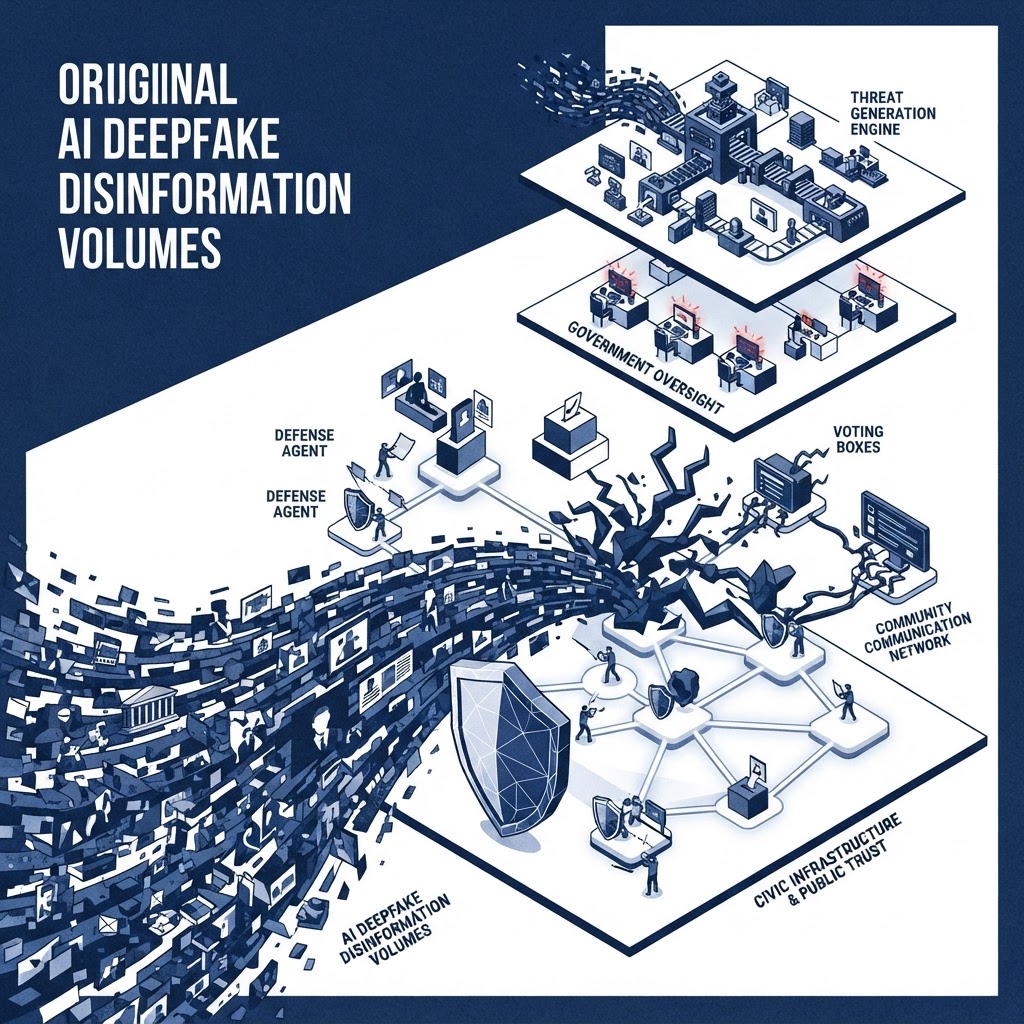
Public sector institutions confront an asymmetric communications landscape where generative toolsets produce ultra-realistic audiovisual forgeries with minimal technical barriers. Authoritative incident data compiled in The Deepfake Threat: Defending Truth in the Age of AI underscores this reality, showing that annual deepfake instances climbed from approximately 500,000 in 2023 to over 8 million by 2025. These deployments target municipal utility supervisors, emergency response teams, and election registrars, seeking to paralyze incident command systems during critical civic events.
Because consumer generative engines frequently slip past basic filtering software, agencies face a persistent response lag when debunking falsified executive orders or manipulated public statements. Under the NIST AI RMF GOVERN 1.2 and MANAGE 2.4 categories, mitigating such cognitive manipulation requires proactive algorithmic accountability rather than reactive press releases. Incorporating enterprise-wide AI DLP safeguards and strict AI acceptable use policy rules prevents agency employees from inadvertently feeding sensitive biometric profiles into external models that bad actors weaponize for synthetic extortion.
What statutory disclosure rules apply to synthetic media across major regulatory jurisdictions?
Under Article 50 of the European Union AI Act, providers and deployers must visibly label AI-generated audio, image, and video media with machine-readable disclosures. Non-compliance exposes organizations to administrative fines reaching up to 35 million euros or 6% of global annual turnover. In the United States, states enforce biometric safeguards via the Illinois Biometric Information Privacy Act (BIPA) and the California Consumer Privacy Act (CCPA).
Global Statutory Mandates Curbing AI Deepfake Disinformation Threats and Regulatory Liabilities
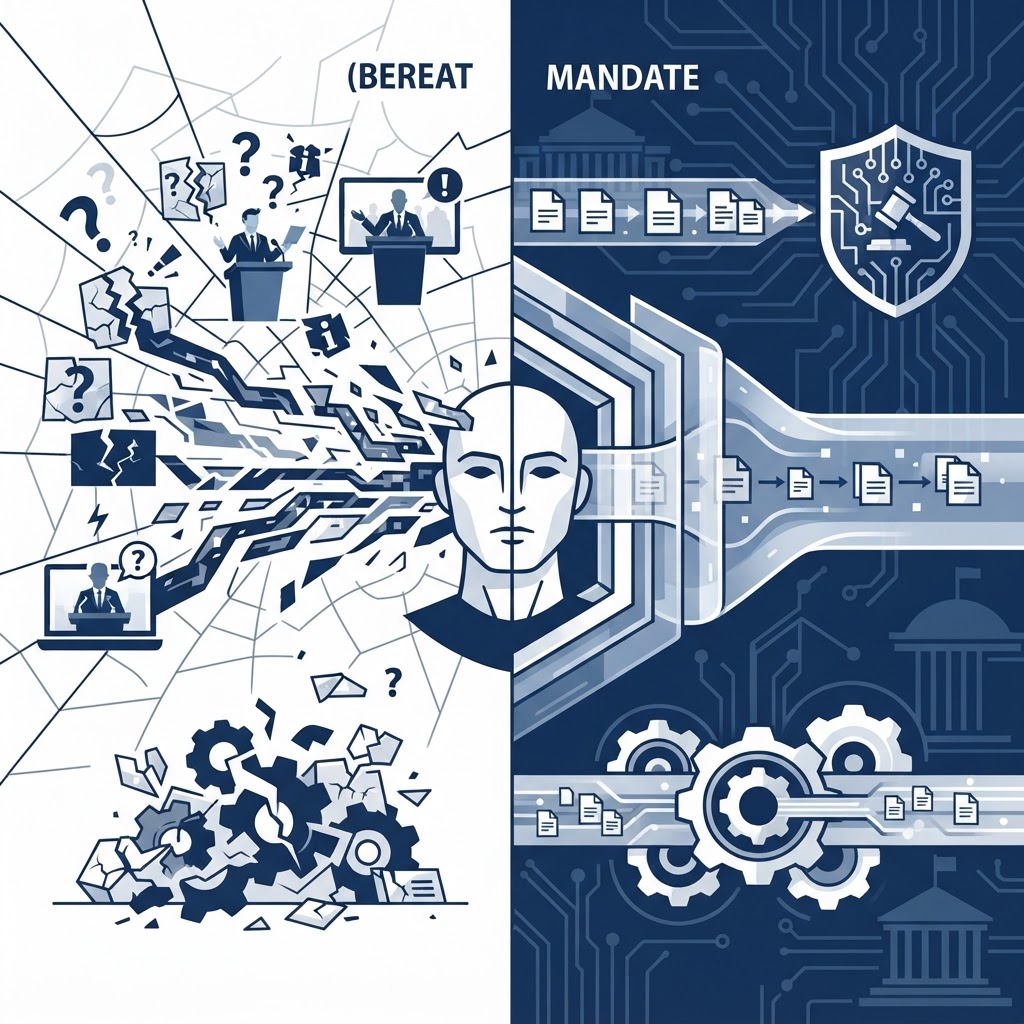
Legislative bodies worldwide have shifted decisively away from voluntary vendor commitments in favor of enforceable statutory mandates carrying severe non-compliance penalties. In Europe, the full implementation of the European Union AI Act establishes strict obligations regarding synthetic transparency. As detailed in the World Economic Forum analysis on How cognitive manipulation and AI will shape disinformation in 2026, Article 50 codifies mandatory watermarking and explicit labeling for synthetic outputs, with corporate fines escalating up to 6% of global turnover.
Simultaneously, legal architectures in the United States adapt biometric consent standards to curb unauthorized digital likeness exploitation. Legal specialists reviewing Artificial illusion: Global governance challenges of deepfake technology point out that statutory frameworks including Illinois' Biometric Information Privacy Act (BIPA) and the California Consumer Privacy Act (CCPA) increasingly penalize unconsented facial and voice cloning. Furthermore, congressional measures modeled on the Deepfake Report Act and proposed TAKE IT DOWN provisions require the Department of Homeland Security to conduct persistent digital forgery assessments, aligning federal oversight directly with state-level administrative guidelines.
Operational Preparedness Across Municipal, County, and Regional Agencies

Municipal, county, and state administrations must modernize their technical infrastructure and intergovernmental incident response blueprints to withstand hyper-targeted deceptive campaigns. Local procurement compliance teams should immediately enforce vendor risk assessments requiring cryptographic signing tools, such as Coalition for Content Provenance and Authenticity (C2PA) metadata, on all enterprise audio, video, and citizen-facing media distribution channels. Jurisdictions cannot treat algorithmic risk management as an isolated IT function; instead, agency chief information security officers must institute an explicit AI governance charter addressing shadow AI tools that staff might adopt outside authorized software stacks.
Furthermore, local election bureaus and emergency management districts must run multi-agency tabletop exercises alongside CISA and state law enforcement units, stress-testing rapid debunking playbooks when counterfeit audio mimics local officials. Without consistent workforce education and verifiable digital audit trails, administrative offices remain exposed to sophisticated cognitive exploitation that degrades municipal public trust.
Actionable Protocols for Public Sector Compliance and Security Personnel
- →Mandate cryptographic content provenance verification across all municipal and county media distributions using standardized C2PA metadata schemas.
- →Align internal software acquisition frameworks with NIST AI RMF MAP and GOVERN profiles to identify third-party generative vulnerabilities and prevent shadow AI adoption.
- →Implement clear biometric consent protocols aligned with BIPA and CCPA guidelines to prevent unauthorized public official likeness cloning.
- →Conduct quarterly interagency tabletop incident response simulations involving local emergency coordinators, public information officers, and regional cybersecurity advisors.
- →Establish an authoritative civic distribution channel utilizing AI DLP solutions to verify official agency bulletins prior to social media dissemination.
Which legal liabilities confront agencies that fail to detect or mitigate deepfake impersonations?
Public agencies face operational disruption, civil rights litigation, and statutory privacy penalties if unauthorized biometric cloning occurs across their digital infrastructure. Failing to implement mandated transparency under rules like EU AI Act Article 50 triggers fines up to 6% of turnover for contractors, while U.S. state statutes like BIPA impose liquidated damages between $1,000 and $5,000 per willful violation of biometric data protections.
Neutralizing sophisticated AI deepfake disinformation threats requires pairing cryptographically verifiable content provenance with robust statutory transparency frameworks. As academic researchers observe in Public Trust in Global AI Governance Across Geopolitical Rivals, enduring institutional credibility depends on transparent, multilateral governance rather than uncoordinated technical mitigations alone. Public sector compliance leaders must continuously audit generative deployments, enforce strict biometric safeguards, and champion civic verification to safeguard public trust against escalating synthetic deception.
Tagged
About APEX AI Guardrails: We publish expert AI news and governance insights updated 4× daily. Our editorial team consists of retired government IT professionals, AI governance specialists, and compliance experts with deep experience in local government operations.
Related Articles
Government AI
AI Hallucination Risk Governance in SLED: September 4 Disciplinary Actions and New Deployer Liability
September 4, 2026
Government AI
AI Transparency Government Decision Making: California Passes 30 Oversight Bills Ahead of September Deadline
September 4, 2026
Government AI
Public Sector Algorithmic Accountability: New Balochistan Civil Service AI Plan Sparks Global Governance Warnings
September 4, 2026