
NIST AI Risk Management Framework Mandate: New Bipartisan Bill Targets Federal Agency Compliance (August 14, 2026)
A new bipartisan bill introduced in August 2026 mandates the adoption of the NIST AI Risk Management Framework for all federal agencies, coinciding with the launch of the tactical TEVV-Athlon framework and updated OMB governance policies.
Published by
APEX AI Guardrails Editorial Team
August 15, 2026
Reading time
7
minutes
A new bipartisan bill introduced on August 12, 2026, seeks to codify the NIST AI Risk Management Framework as a mandatory requirement for all federal agencies, transitioning it from voluntary guidance to a strict regulatory baseline. Following the concurrent launch of the TEVV-Athlon methodology and the replacement of the legacy OMB M-24-10 memo with the M-25-21 policy suite, the government is signaling a decisive move toward tactical AI accountability. This evolution is critical for Chief AI Officers and procurement specialists who must now navigate a complex landscape of mandatory acquisition protocols, automated risk prioritization, and rigorous safety testing.
How does the Lieu-Nunn-Beyer bill introduced in August 2026 change compliance for federal agencies using the NIST AI Risk Management Framework?
The Lieu-Nunn-Beyer bill, introduced on August 12, 2026, transitions the NIST AI Risk Management Framework from a voluntary resource to a mandatory requirement for all federal agencies. This legislative shift forces Chief AI Officers (CAIOs) to provide public-facing justifications for AI deployments, ensuring that every algorithmic system meets specific safety and transparency benchmarks defined by NIST, effectively ending the era of discretionary framework adoption in the federal sector.
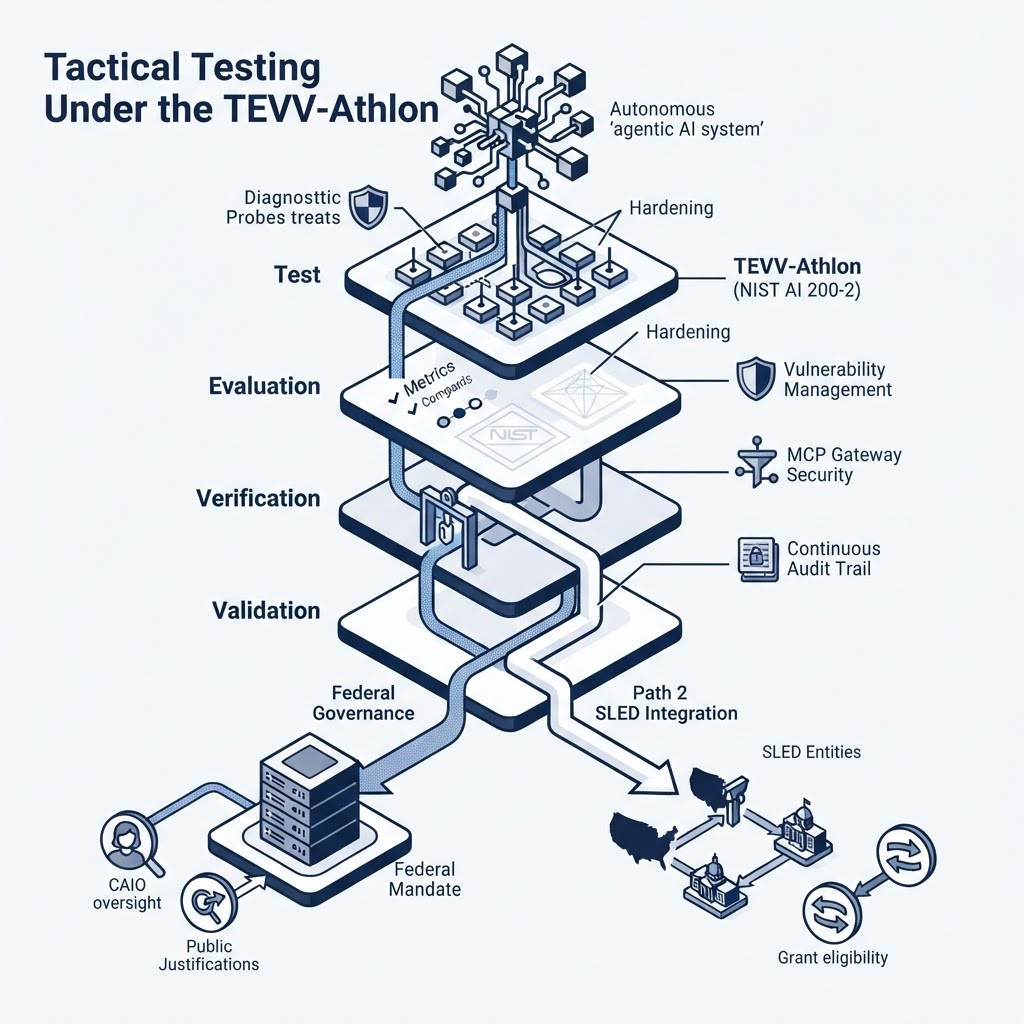
Tactical Testing Under the TEVV-Athlon: Hardening the NIST AI Risk Management Framework
On August 7, 2026, NIST significantly expanded the operational depth of the NIST AI Risk Management Framework by releasing NIST AI 200-2, also known as the TEVV-Athlon framework. This four-stage methodology represents a critical transition from high-level strategic planning to a tactical manual for the Test, Evaluation, Verification, and Validation (TEVV) of AI systems. Agencies are now expected to move beyond general risk assessments and engage in rigorous, structured testing of agentic systems, which are AI models capable of autonomous goal-seeking and complex multi-step reasoning.
By standardizing TEVV, NIST aims to ensure that AI applications meet specific organizational goals while minimizing unintended negative consequences or hallucinations that could compromise public trust. The framework provides specific metrics for measuring model reliability and safety, which is essential as federal entities integrate AI into more sensitive operational areas. This tactical hardening is not just about security; it is about establishing a verifiable chain of accountability for AI-driven decisions.
As agencies adopt TEVV-Athlon, they must document each stage of evaluation, creating a comprehensive audit trail that supports the broader goals of the AI RMF. This level of granularity is designed to address the unique challenges posed by generative models and autonomous agents, which traditional software testing methods often fail to capture effectively. Compliance teams are urged to integrate these benchmarks into their AI acceptable use policies immediately to avoid deployment delays.
What specific technical requirements does the new TEVV-Athlon (NIST AI 200-2) impose on agency AI assessments?
The TEVV-Athlon framework requires a four-stage process consisting of Test, Evaluation, Verification, and Validation to harden AI infrastructure. According to the NIST AI 200-2 publication, agencies must now utilize tactical manuals to assess agentic systems and autonomous goal-seeking models. This methodology ensures that AI systems are not only performant but also align with specific safety protocols and organizational objectives before full-scale deployment in federal environments.
Policy Migration and the OMB M-25-21 Suite for the NIST AI Risk Management Framework
The governance landscape shifted further on August 11, 2026, as federal agencies began a full transition to the OMB M-25-21 policy suite, which replaces the legacy M-24-10 Advancing AI Governance memorandum. This update is not merely administrative; it integrates the latest NIST AI Risk Management Framework profiles directly into mandatory acquisition and deployment protocols. Under M-25-21, agencies are required to update their AI use case inventories to reflect these new 2026 standards, ensuring that every tool—from simple automation to complex neural networks—is vetted against a uniform set of trust and safety criteria.
A key component of this migration is the inclusion of the NIST AI RMF Profile on Trustworthy AI in Critical Infrastructure, which has immediate implications for SLED entities that rely on federal grants or inter-agency data sharing. Furthermore, the Lieu-Nunn-Beyer bill reinforces this policy by requiring CAIOs to provide public justifications for AI use, creating a new layer of algorithmic accountability. This legislative and executive pincer movement ensures that the NIST AI RMF is the centerpiece of the federal AI strategy, leaving little room for shadow AI or unvetted pilot programs.
Agencies that fail to align their inventories with these new standards by the impending deadlines risk losing procurement authority for emerging technologies. This policy shift effectively mandates responsible AI as a core component of digital transformation rather than an optional safeguard.
Bridging the Gap: How State and Local Entities Must Respond to the Federal Governance Pivot
While the recent legislative and executive actions primarily target federal agencies, their impact on state, local, and educational (SLED) organizations is profound. Traditionally, SLED procurement offices follow federal leads to ensure future-proofed technology investments. With the bipartisan bill and OMB M-25-21 making the NIST AI RMF a mandatory standard, many state CIOs are already moving to adopt similar policies to maintain inter-agency interoperability.
This is particularly urgent given the NIST RFI published on August 12, 2026, which seeks to leverage AI in modernizing the National Vulnerability Database (NVD). The NVD modernization is a response to the staggering 72% surge in reported software vulnerabilities, with over 50,000 defects reported in the first eight months of 2026 alone. SLED agencies must now account for lateral movement risks within Model Context Protocol (MCP) gateways—a new class of vulnerability that traditional firewalls may miss.
Local governments must prioritize staff training and update their AI governance charters to mirror the federal TEVV-Athlon standards. By aligning local procurement standards with the NIST AI RMF now, SLED leaders can avoid costly retrofitting of AI systems when state-level versions of the Lieu-Nunn-Beyer bill arrive. This proactive stance is essential for maintaining cyber resilience against the growing wave of AI-augmented threats targeting public infrastructure.
Essential Steps for Organizations Aligning with the 2026 NIST Standards
- →Implement the four-stage TEVV-Athlon methodology (NIST AI 200-2) for all agentic and autonomous AI systems currently in pilot phases to ensure system validation. • Audit all current AI use case inventories to ensure compliance with the mandatory OMB M-25-21 acquisition protocols and critical infrastructure profiles. • Prepare public-facing compliance justifications for every high-risk AI deployment to satisfy the requirements of the new Lieu-Nunn-Beyer bipartisan bill. • Integrate AI-driven vulnerability management tools to address the 72% surge in software defects identified in the recent NIST NVD modernization RFI. • Assess Model Context Protocol (MCP) gateways for lateral movement risks, especially in environments where AI interacts with sensitive public sector data repositories. • Realign SLED procurement standards to match the mandatory federal NIST AI RMF requirements to ensure long-term inter-agency data sharing and grant eligibility.
What are the consequences for government agencies that fail to modernize their vulnerability management under the new August 2026 NIST guidelines?
Agencies failing to modernize face extreme risk from an AI-augmented vulnerability tsunami. As NIST researchers warned on August 14, 2026, AI-enabled cyber tools are overwhelming traditional management systems. Failure to adopt the new automated 'contextual' risk prioritization standards could lead to catastrophic breaches, loss of federal procurement authority under OMB M-25-21, and legal repercussions under the bipartisan Lieu-Nunn-Beyer mandate for algorithmic accountability and system validation.
The evolution of the NIST AI Risk Management Framework from a set of voluntary principles to a mandatory legislative and executive requirement marks a turning point in public sector technology governance. By integrating tactical testing through the TEVV-Athlon framework and modernizing vulnerability management with automated AI tools, the federal government is setting a high bar for safety and reliability. Compliance leaders must act immediately to align their governance charters and procurement standards with these new requirements to ensure the responsible and secure deployment of autonomous systems in the years to come.
Sources
- NIST Introduces TEVV-Athlon Framework for AI System Assessment
- Bipartisan Bill Proposes Codifying NIST AI RMF for Federal Agencies
- NIST Seeks AI-Driven Modernization for National Vulnerability Database
- Federal AI Governance Pivot: OMB Replaces M-24-10 with M-25-21 Standards
- NIST AI Safety Tsunami: Addressing AI-Augmented Vulnerability Discovery
Tagged
About APEX AI Guardrails: We publish expert AI news and governance insights updated 4× daily. Our editorial team consists of retired government IT professionals, AI governance specialists, and compliance experts with deep experience in local government operations.
Related Articles
Government AI
AI Hallucination Risk Governance in SLED: September 4 Disciplinary Actions and New Deployer Liability
September 4, 2026
AI Governance
AI Deepfake Disinformation Threats: Global Governments Ramp Up Oversight in September 2026
September 4, 2026
Government AI
AI Transparency Government Decision Making: California Passes 30 Oversight Bills Ahead of September Deadline
September 4, 2026