
NIST AI Risk Management Framework: Federal Unified Standards Push Launched August 2026
The federal government has initiated a significant push to unify AI standards under the NIST AI Risk Management Framework, effectively preempting a patchwork of state-level laws. This development is accompanied by new CISA-accredited certifications designed to address the ownership gap in AI risk management across public sector agencies.
Published by
APEX AI Guardrails Editorial Team
August 13, 2026
Reading time
8
minutes
As of August 12, 2026, the NIST AI Risk Management Framework has become the cornerstone of a strategic federal effort to unify artificial intelligence oversight and eliminate the growing patchwork of state-level regulations. The Trump administration is currently asserting federal authority to ensure that American innovation is not hindered by localized safety mandates, citing the framework as the essential foundation for a consistent national policy. For government IT and compliance leaders, this represents a definitive shift toward a centralized accountability model that requires immediate alignment with federal standards to mitigate liability and operational risk.
How is the U.S. federal government centralizing AI oversight as of August 2026?
The federal government is currently moving to preempt diverse state-level AI laws by proposing a unified national legislative framework centered on the NIST AI Risk Management Framework. As of August 12, 2026, the administration has begun issuing formal guidance to state lawmakers to prevent independent regulations that might fragment the technological landscape. This initiative aims to establish a single, robust compliance baseline across all jurisdictions to facilitate safer and faster AI deployment.
The Push for Unified National AI Governance
The landscape of American technology policy reached a significant milestone this week as federal authorities moved to assert dominance over the regulation of emerging technologies. Who governs AI? The federal government's challenge to state regulation highlights that August 12, 2026, represents a critical inflection point where the patchwork of individual state safety mandates is being formally challenged by Washington. The current administration argues that a fragmented regulatory environment creates unnecessary friction for developers and public sector agencies alike, potentially ceding ground in the global technological race.
By utilizing the Regulation of artificial intelligence in the United States as a guide, federal officials are pushing for a national standard that leverages the NIST AI Risk Management Framework to provide a predictable roadmap for innovation. This legislative push is designed to ensure that state-level rules do not inadvertently hinder the national objective of maintaining technological leadership. Legal experts note that this move seeks to resolve jurisdictional conflicts that have plagued algorithmic accountability efforts, moving toward a Govern and Map phase that is consistent from coast to coast.
Furthermore, the administration has begun sending correspondence to state legislatures, warning that individual state bills could create a compliance nightmare for companies operating across state lines. This centralization strategy aims to provide a single pane of glass for AI governance, allowing the federal government to set the pace for safety and security protocols that every state and local agency must follow. The emphasis is on creating a streamlined environment where the NIST AI Risk Management Framework serves as the primary benchmark for all domestic AI activity, ensuring that state-level nuances do not compromise national security or economic interests.
What does the August 2026 CISA update mean for professionalizing AI risk management within agencies?
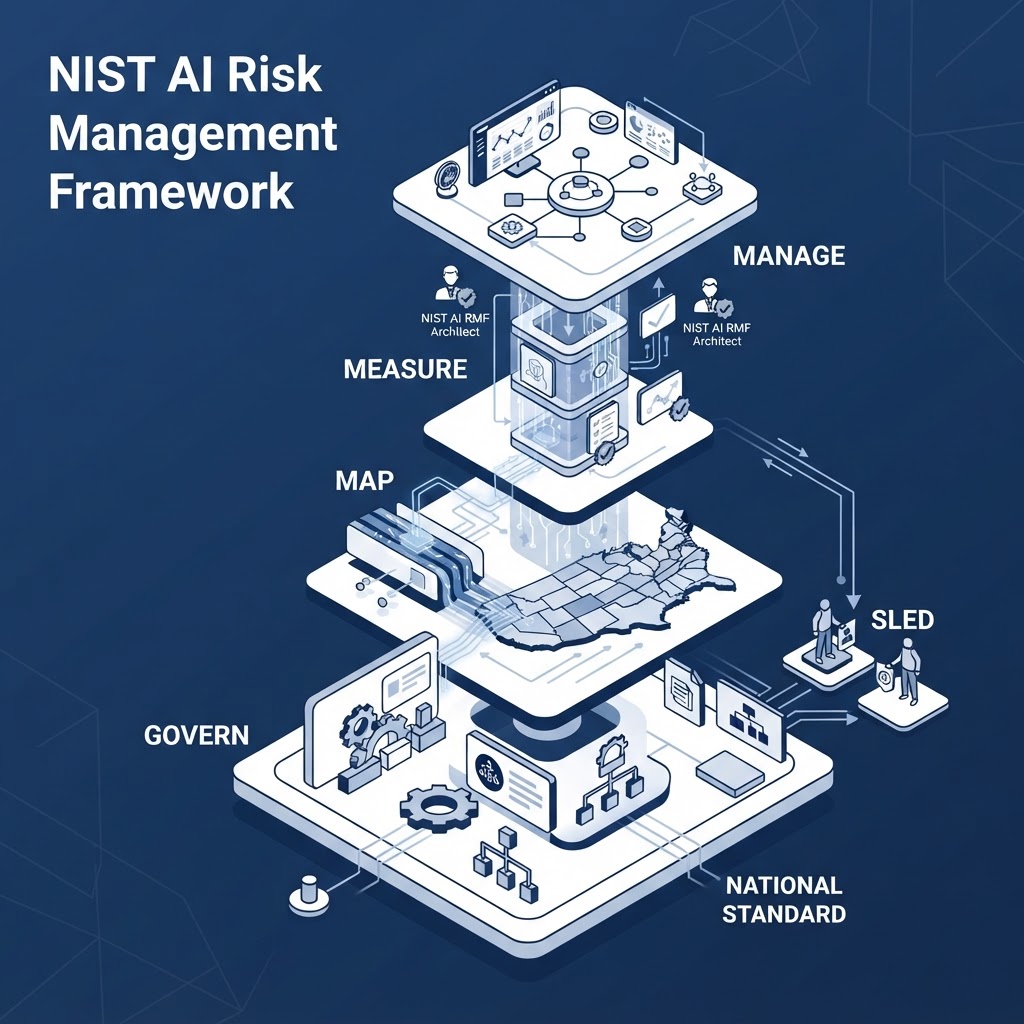
On August 11, 2026, CISA updated its National Initiative for Cybersecurity Careers and Studies (NICCS) catalog to include an accredited certification for NIST AI RMF 1.0 Architects. This program professionalizes the role by requiring mastery of the framework's four functions: Govern, Map, Measure, and Manage. It addresses the ownership gap in public sector organizations, ensuring that boards and agency leaders can identify specific individuals responsible for mitigating AI-related risks.
Professionalizing AI Risk: The Rise of the AI RMF Architect
The professionalization of AI safety has taken a major leap forward with new educational mandates for the public sector workforce. Accredited NIST AI Risk Management Framework (AI RMF 1.0) Architect Training & Certification was added to the CISA training catalog on August 11, 2026, specifically to address the widespread ownership gap currently hindering risk management. For too long, agency leaders and executive boards have struggled to define who exactly is responsible for the performance and ethics of automated systems. By establishing a certified Architect role, the federal government is institutionalizing the four core functions of the NIST framework: Govern, Map, Measure, and Manage.
This certification ensures that personnel have the technical skills to implement algorithmic accountability while also understanding the high-level governance requirements necessary for federal compliance. As agencies move away from ad-hoc oversight, these certified professionals will serve as the primary bridge between technical security controls and the ethical mandates required by new executive oversight. This move is expected to significantly reduce the prevalence of Shadow AI, where unauthorized tools are deployed without formal risk assessment or data loss prevention (DLP) protocols in place.
The training specifically focuses on how to Measure the impact of bias and Manage the lifecycle of a model from deployment to eventual retirement. By creating a standardized certification, CISA is providing a clear pathway for IT professionals to transition into high-level governance roles that are now essential for maintaining public trust and ensuring that AI tools operate within defined guardrails. The curriculum also delves into adversarial machine learning and the necessity of maintaining robust AI governance charters that evolve with technological progress.
Operational Shifts for State and Local Public Sector Entities
For counties, municipalities, and state-level agencies, this federal consolidation necessitates a rapid pivot in procurement and operational strategy. The adoption of the NIST AI Risk Management Framework as a national baseline means that local IT directors can no longer rely solely on state-specific guidelines, which are now being preempted by Washington’s unified vision. This shift impacts everything from vendor risk assessments to the drafting of an AI Acceptable Use Policy.
Municipalities must now ensure that any AI-driven service meets the rigorous documentation standards required by the July 2026 Executive Order. As AI Policy and Regulation: Key Updates from August 2026 points out, mandatory impact assessments are now a prerequisite for deployment. This requires local governments to integrate technical security controls directly with high-level governance processes.
Agencies that fail to align their procurement compliance with these federal standards face not only technical vulnerabilities but also significant legal liability under the new federal implementation rules. Procurement officers at the local level are encouraged to update their Request for Proposals (RFPs) to explicitly demand adherence to NIST standards, ensuring that third-party vendors are held to the same algorithmic accountability standards as federal agencies. This proactive approach helps mitigate the risks of data leakage and ensures that the public sector remains a responsible steward of citizen data in an increasingly automated world.
Furthermore, small municipalities are exploring shared service agreements to jointly fund a certified NIST AI RMF Architect, ensuring they have the necessary oversight without exceeding their budgetary constraints. This collaborative model is becoming a necessity as federal mandates for algorithmic transparency and AI DLP become more stringent across the entire public sector landscape.
Immediate Action Steps for Public Sector Compliance Officers
- →Conduct immediate audits of all automated systems to ensure alignment with the four core NIST AI RMF functions of Govern, Map, Measure, and Manage. • Appoint a certified NIST AI RMF Architect to bridge the ownership gap between technical teams and executive leadership within the agency. • Execute mandatory AI impact assessments for all new and existing deployments as required by the July 2026 Executive Order on AI Liability. • Update procurement compliance documents to require vendors to provide transparent algorithmic accountability reports and security documentation. • Establish a formal AI Acceptable Use Policy to mitigate the risks associated with Shadow AI and unauthorized tool usage by staff. • Review state-level AI safety mandates against new federal preemption guidelines to avoid conflicting regulatory compliance efforts and legal friction.
What specific liabilities do public sector leaders face under the July 2026 Executive Order on AI?
Under the implementation rules of the July 2026 Executive Order, federal and SLED agencies are now legally required to conduct rigorous AI impact assessments before any tool deployment. Failure to document these assessments can lead to enforcement actions, loss of federal funding, and increased exposure to litigation regarding algorithmic bias or security failures. These rules link technical security controls directly to high-level governance, making agency leaders personally accountable for oversight failures.
The emergence of the NIST AI Risk Management Framework as a unified national standard marks the end of regulatory fragmentation for government technology. By professionalizing risk through CISA-accredited certifications and mandating rigorous impact assessments, the federal government is ensuring that AI innovation does not outpace essential oversight. Compliance leaders must act now to institutionalize these frameworks or risk significant legal and operational consequences in this new era of centralized governance.
Tagged
About APEX AI Guardrails: We publish expert AI news and governance insights updated 4× daily. Our editorial team consists of retired government IT professionals, AI governance specialists, and compliance experts with deep experience in local government operations.
Related Articles
Government AI
AI Hallucination Risk Governance in SLED: September 4 Disciplinary Actions and New Deployer Liability
September 4, 2026
AI Governance
AI Deepfake Disinformation Threats: Global Governments Ramp Up Oversight in September 2026
September 4, 2026
Government AI
AI Transparency Government Decision Making: California Passes 30 Oversight Bills Ahead of September Deadline
September 4, 2026