
NIST AI Risk Management Framework 2026 Revision: New Mandates for Government Agencies
NIST is currently revising its AI Risk Management Framework 1.0 to align with the latest White House AI Action Plan, introducing new Generative AI profiles and critical infrastructure guidance for 2026. This article explores how state and local government agencies must adapt to these emerging federal mandates to ensure algorithmic accountability and procurement compliance.
Published by
APEX AI Guardrails Editorial Team
August 24, 2026
Reading time
7
minutes
As of August 24, 2026, the NIST AI Risk Management Framework is undergoing a major revision to meet the aggressive security and trustworthiness benchmarks set by the latest White House AI Action Plan. This evolution arrives at a critical juncture as the federal government seeks to harmonize fragmented state-level oversight with a unified national standard for algorithmic accountability. For state and local government (SLED) leaders, these updates transition AI safety from a voluntary suggestion to a cornerstone of procurement compliance and inter-agency data sharing.
Will the 2026 NIST AI RMF updates change how state agencies evaluate generative AI tools?
Yes, the 2026 revision integrates the NIST AI 600-1 profile, which provides specific guidance for managing generative AI risks like synthetic content and data leakage. According to NIST, state agencies must now use these cross-sectoral standards to evaluate model trustworthiness before deployment. This ensures that large language models used in public service align with the broader White House AI Action Plan benchmarks for safety and transparency.
The 2026 Revision of NIST AI Risk Management Framework: Aligning with the White House AI Action Plan
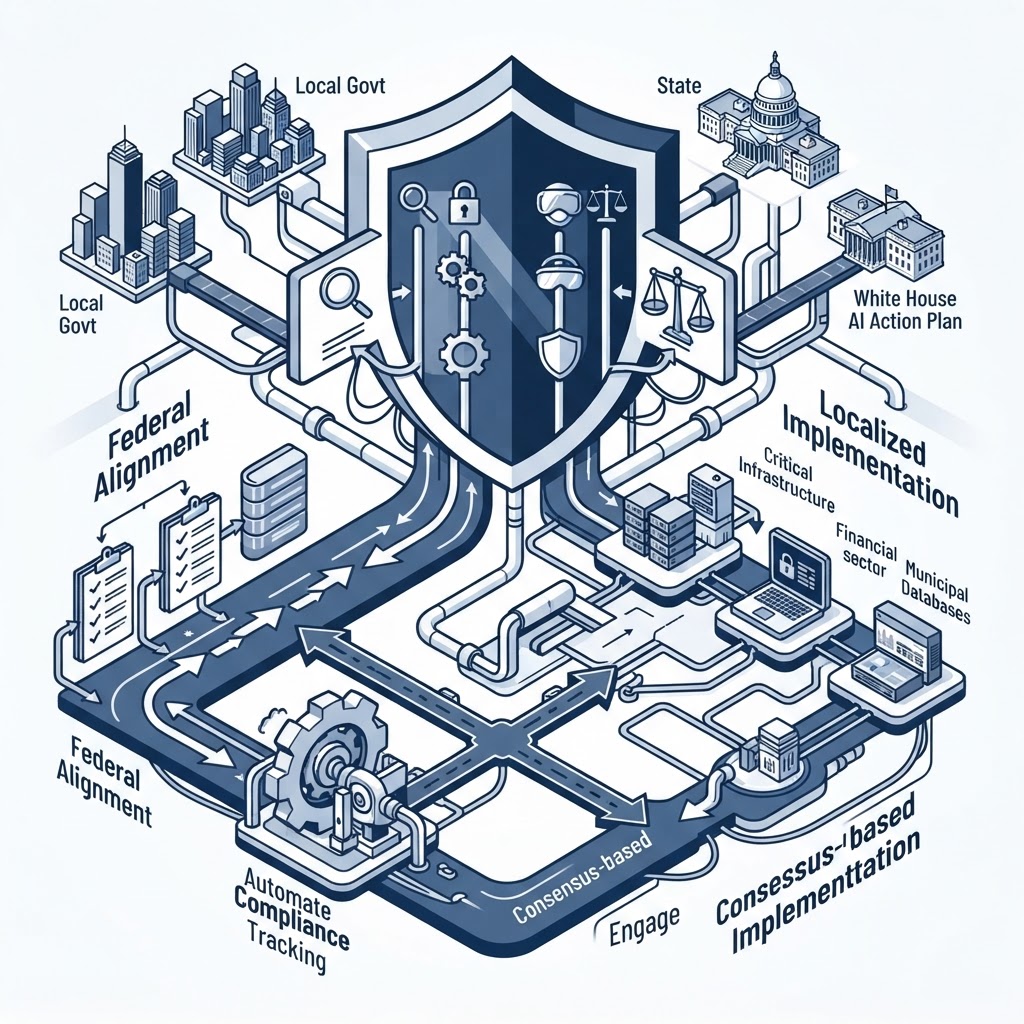
The revision process for the NIST AI Risk Management Framework is currently being driven by a consensus-based model that prioritizes public and private sector input to address the rapid advancements in automated systems. As part of the White House AI Action Plan, the update aims to provide a more granular approach to defining AI trustworthiness. This includes expanding on the seven key characteristics: validity and reliability, safety, security and resilience, accountability and transparency, explainability and interpretability, privacy-enhanced features, and fairness with harmful bias managed.
For SLED agencies, this means that future audits will likely require specific documentation regarding how each of these characteristics is being addressed within their technological stack. The framework revision is designed to be living and evergreen, adapting to new threats as they emerge in the generative AI landscape. The AI Risk Management Framework | NIST remains the gold standard for this transition, providing the necessary vocabulary for agencies to communicate risk with vendors and federal oversight bodies.
By participating in the revision process, local government IT leaders can ensure that the final 2026 standards do not impose undue burdens on smaller municipalities while still maintaining a high bar for public safety. NIST has emphasized that the engage platform, accessible via the AI Risk Management Framework - Engage | NIST, is the primary vehicle for this collaborative development, offering crosswalks and roadmap updates that are essential for long-term strategic planning in the public sector.
What is the recommended path for agency-wide adoption of the new NIST standards?
Agencies should start by utilizing the NIST AI RMF Playbook to map their existing AI inventory against the framework's core functions. Following the 2026 guidance, departments should then apply the specific Generative AI Profile (NIST AI 600-1) to high-priority projects. Finally, IT leaders must automate compliance tracking to ensure that as the White House AI Action Plan evolves, the agency’s risk posture remains updated and audit-ready.
The NIST AI Risk Management Framework as a National Standard: Federal vs. State Regulatory Supremacy
The current tension between federal and state authorities marks a defining moment in the history of American technology policy. As states like Colorado and California have introduced their own AI regulations, the federal government has begun to assert that a single, unified national standard is required for the digital economy to function effectively. A recent analysis by [Who governs AI?
The federal government's challenge to state regulation](https://www.reuters.com/legal/legalindustry/who-governs-ai-federal-governments-challenge-state-regulation-what-organizations--pracin-2026-08-12/) highlights how federal authorities are increasingly challenging state-level regulations to create a unified national standard. This makes the NIST AI Risk Management Framework more than just a voluntary guide; it is becoming the de facto legal benchmark for federal preemption arguments. For state agencies, this means that procurement policies must be flexible enough to accommodate local laws while remaining strictly aligned with federal NIST standards to avoid losing access to federal data and funding.
The challenge lies in managing these dual compliance requirements, especially as the federal government aims to streamline regulations to support national security interests. Consequently, SLED agencies are being advised to treat the NIST framework as the base layer for all emerging federal compliance expectations, ensuring that their internal policies are robust enough to withstand both state scrutiny and federal preemption challenges while fostering responsible AI innovation.
Impact Assessment for Localized Governance: Implementing Generative AI Profiles
To move from theoretical governance to operational reality, agencies are increasingly relying on the Artificial Intelligence Risk Management Framework: Generative Artificial Intelligence Profile. This specific profile, known as NIST AI 600-1, provides the technical implementation guidance necessary to manage the unique risks of large language models, such as hallucination, synthetic content risks, and prompt injection. Furthermore, sector-specific templates are emerging to simplify the process; for instance, a dedicated guidance update for financial institutions was released in February 2026 to streamline compliance, as noted in the research on NIST AI RMF: Understanding The Risk Management Framework.
These templates offer a proven path for other government departments—such as Treasury or local tax offices—to streamline their compliance efforts. Implementation strategies now frequently involve the use of AI DLP (Data Loss Prevention) and automated governance tools that map internal workflows directly to NIST subcategories like Govern, Map, Measure, and Manage. Additionally, new concept notes released in April 2026 for Critical Infrastructure guide operators on securing AI-enabled power grids and water systems.
By adopting these profiles, SLED agencies can move beyond shadow AI and toward a structured AI governance charter that satisfies both the public's demand for transparency and the government's requirement for robust security and algorithmic accountability.
Strategic Action Plan for Public Sector Compliance
- →Conduct an immediate audit of all department-level AI applications using the NIST AI RMF Playbook to identify and categorize high-risk generative tools. • Integrate the NIST AI 600-1 Generative AI Profile into procurement contracts to force vendors to disclose training data transparency and bias mitigation efforts. • Establish an internal AI governance charter that designates specific personnel responsible for algorithmic accountability and regular risk assessments. • Monitor the NIST AI RMF Engage portal for the release of new crosswalks that map federal standards to existing state privacy laws and AI acceptable use policies. • Implement AI DLP solutions to prevent sensitive citizen data from being used as training input for external large language models without explicit consent. • Review the February 2026 financial sector guidelines as a template for developing internal risk management protocols for municipal revenue and budgeting systems.
Which liabilities define the current AI landscape for municipalities failing to adopt the revised framework?
Municipalities face increased liability regarding algorithmic bias in public services and the risk of catastrophic failures in AI-managed critical infrastructure. Without aligning to the NIST AI Risk Management Framework, local governments are vulnerable to federal oversight actions and private litigation if AI systems produce discriminatory outcomes. Furthermore, non-compliance can lead to the revocation of federal cybersecurity grants intended for modernization and risk mitigation under the White House AI Action Plan.
The 2026 revision of the NIST AI Risk Management Framework signals a new era of mandatory algorithmic accountability for all levels of government. By aligning procurement and operational policies with these federal benchmarks, SLED agencies can mitigate risk while maintaining access to critical federal resources and ensuring AI transparency. As the regulatory landscape continues to shift, staying engaged with the NIST roadmap remains the most effective way for IT leaders to ensure long-term technological resilience and public trust in the public sector.
Sources
Tagged
About APEX AI Guardrails: We publish expert AI news and governance insights updated 4× daily. Our editorial team consists of retired government IT professionals, AI governance specialists, and compliance experts with deep experience in local government operations.
Related Articles
Government AI
AI Hallucination Risk Governance in SLED: September 4 Disciplinary Actions and New Deployer Liability
September 4, 2026
AI Governance
AI Deepfake Disinformation Threats: Global Governments Ramp Up Oversight in September 2026
September 4, 2026
Government AI
AI Transparency Government Decision Making: California Passes 30 Oversight Bills Ahead of September Deadline
September 4, 2026