
Combating AI Deepfake Disinformation Threats: New October 6 Legislative Frontiers for Government Trust
Government leaders face an urgent landscape of AI-driven synthetic media risks requiring robust digital provenance and active information defense. New international and state-level mandates are shifting how agencies must verify content to maintain integrity.
Published by
APEX AI Guardrails Editorial Team
October 6, 2026
Reading time
6
minutes
AI deepfake disinformation threats are rapidly outpacing conventional detection methods, forcing state and local agencies to adopt strict new digital provenance requirements. As of October 2026, the intersection of synthetic media and political discourse has necessitated immediate oversight to preserve institutional credibility. Government IT and compliance leaders must prioritize these strategies to mitigate risks to shared reality and public trust.
How are new laws specifically targeting AI deepfake disinformation threats in election cycles?
As of August 2, 2026, the EU AI Act and California AI Transparency Act mandate that AI companies embed verifiable provenance data into generated content. Additionally, 29 U.S. states now have specific deepfake election laws in effect. These frameworks aim to standardize content labeling, allowing agencies to track synthetic media origins and reduce the proliferation of untraceable, high-impact disinformation during critical public voting windows.
The Strategic Shift Toward Active Information Defense
The threat environment has fundamentally evolved from passive detection to active disruption as AI-generated misinformation gains sophistication. According to a report on election integrity, synthetic media is eroding public trust by flooding information ecosystems with content that mimics reality beyond the reach of traditional moderation. The United Kingdom has responded by establishing a National Centre for Information Defence, which aims to actively disrupt disinformation threats rather than simply monitoring content after it has already influenced the public discourse.
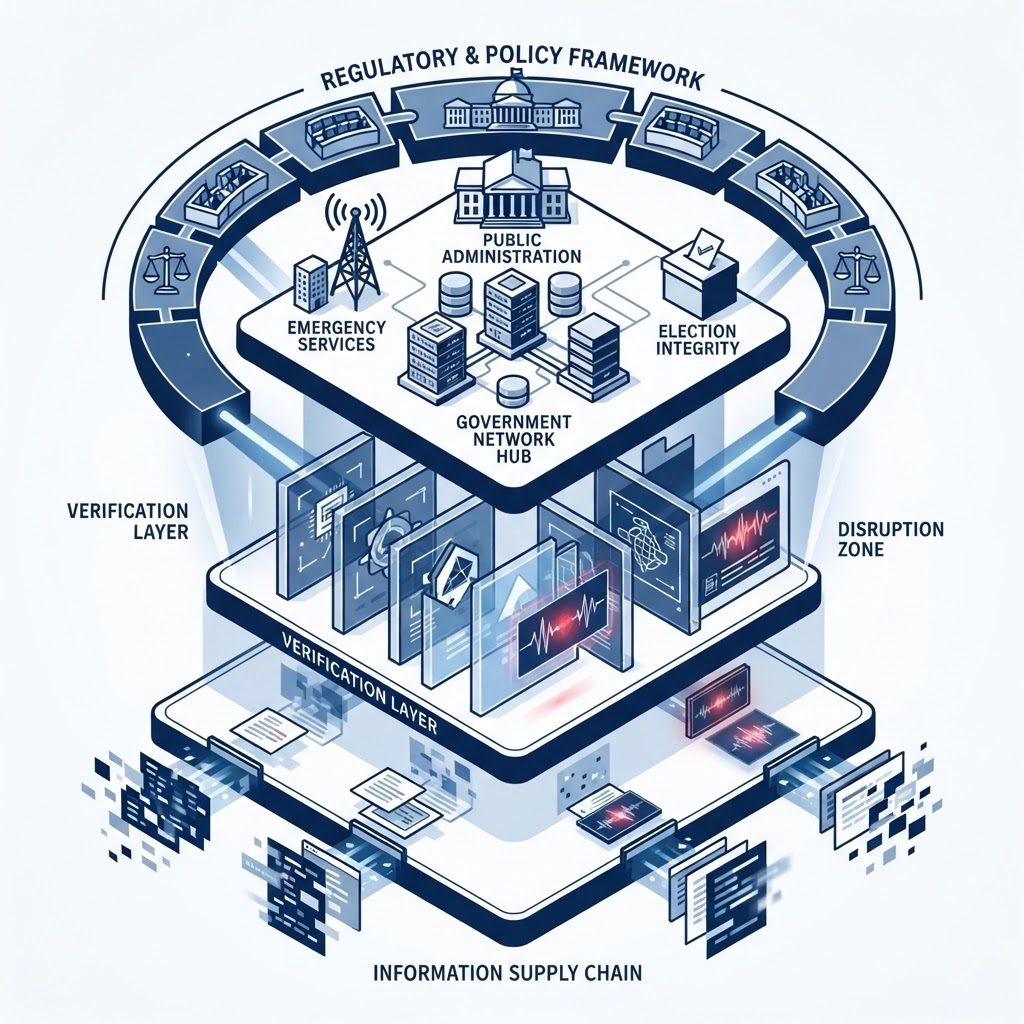
For state, local, and education (SLED) leaders, this shift requires a transition toward building resilience within the information supply chain itself. Organizations must integrate algorithmic accountability into their broader cybersecurity postures, acknowledging that traditional perimeter defense is insufficient against AI-driven campaigns. By leveraging the NIST AI Risk Management Framework (RMF), agencies can identify specific high-risk areas where deepfakes could destabilize critical government functions, from tax administration to emergency communications, ensuring that internal verification tools are ready to combat synthetic impersonations before they propagate widely.
What steps should IT departments take to ensure compliance with emerging AI provenance laws?
IT departments should implement a multi-layered verification strategy by requiring vendors to provide digital signatures for all AI-generated content. Agencies must audit existing procurement policies to ensure compliance with the California AI Transparency Act and similar mandates. Furthermore, leaders should establish an internal AI acceptable use policy that mandates the documentation of provenance data, effectively treating AI-generated media as high-risk digital assets requiring standard cybersecurity lifecycle management.
Legislative Friction and the Global Regulatory Clock
Global governance bodies are issuing urgent warnings regarding the shrinking window for effective regulation of artificial intelligence. As noted by the UN human rights chief on October 5, 2026, the global urgency for AI regulation is at an all-time high, with international dialogue becoming a prerequisite for managing AI deepfake disinformation threats effectively. This regulatory movement faces internal challenges in the United States, where a fragmented landscape creates compliance headaches for multistate agencies.
Currently, twenty-nine states have active laws regarding election deepfakes; however, some of these statutes are currently tied up in court due to First Amendment legal challenges. This legal volatility means that while agencies must prepare for strict compliance, they must also remain agile in their policy development. Effective governance now demands that leaders monitor these regional legislative fluctuations while maintaining a baseline of responsible AI use that aligns with federal CISA guidance and the NIST AI RMF.
By focusing on verifiable identity and transparent content labeling, government entities can maintain public trust even while the legal environment continues to evolve through the courts and legislative chambers.
Navigating Impact and Procurement for Municipal Agencies
Municipalities and county governments are on the front lines of the AI deepfake disinformation threats crisis, often lacking the enterprise-level resources to fight sophisticated social engineering. When procuring new AI-enabled software, departments must shift from generic security questionnaires to deep-dive provenance audits, ensuring every vendor can verify the origin and intent of their content generation engines. This process involves updating procurement contracts to require strict adherence to evolving state transparency laws, thereby offloading a portion of the risk to the software developer.
Additionally, agencies should invest in internal staff training that focuses on identifying synthetic media signatures, a critical gap in many existing AI acceptable use policies. By establishing an AI governance charter that specifically addresses deepfake risks, municipal leaders can move beyond passive monitoring. This proactive stance includes conducting regular tabletop exercises that simulate synthetic misinformation campaigns, allowing agencies to test their response times and communication protocols.
Closing these policy gaps is not merely a technical necessity but a fundamental requirement for maintaining the sanctity of government operations. When the public can no longer distinguish between genuine communication and AI-driven impersonation, the effectiveness of civic services suffers; therefore, investment in verification technology and employee training must become a standard operational expenditure.
Actionable Steps for Government Resilience
- →Audit current vendor contracts to verify that AI-generated content includes tamper-proof provenance metadata compliant with recent state legislation. • Adopt the NIST AI RMF as the foundational framework for assessing and mitigating the risks associated with AI deepfake disinformation threats. • Establish a cross-departmental AI governance committee to evaluate emerging risks to public trust and operational communications. • Implement robust identity verification protocols for all high-level executive and public-facing communications to prevent unauthorized synthetic impersonation. • Participate in state-level information-sharing forums to stay updated on the legal status of deepfake regulations and potential First Amendment impacts. • Incorporate AI-driven misinformation detection tools into existing DLP systems to scan for and quarantine potential synthetic threats.
What are the primary legal consequences for agencies that fail to verify AI-generated content?
Agencies face severe risks including legal liability, loss of public trust, and exposure to misinformation campaigns that can disrupt critical services. Non-compliance with state-level mandates like the California AI Transparency Act can lead to regulatory penalties and litigation. Furthermore, failing to verify synthetic content can result in reputational damage that undermines the legitimacy of official communications, making government agencies vulnerable to mass manipulation and eroding institutional transparency.
Addressing AI deepfake disinformation threats requires a commitment to radical transparency through digital provenance and institutional vigilance. As the regulatory landscape shifts, government leaders must adapt their security infrastructure to meet these global standards for responsible AI governance. Only by proactively verifying the origin of all digital media can agencies ensure the continued trust and security of the constituents they serve.
Tagged
About APEX AI Guardrails: We publish expert AI news and governance insights updated 4× daily. Our editorial team consists of retired government IT professionals, AI governance specialists, and compliance experts with deep experience in local government operations.