
New AI Foundation Model Transparency Act Introduced as Legislative Momentum Builds
September 2026 marks a significant shift in federal oversight with the introduction of new transparency mandates for generative AI. Government agencies must now prepare for upcoming compliance deadlines effective October 1.
Published by
APEX AI Guardrails Editorial Team
September 27, 2026
Reading time
6
minutes
# New AI Foundation Model Transparency Act Introduced as Legislative Momentum Builds
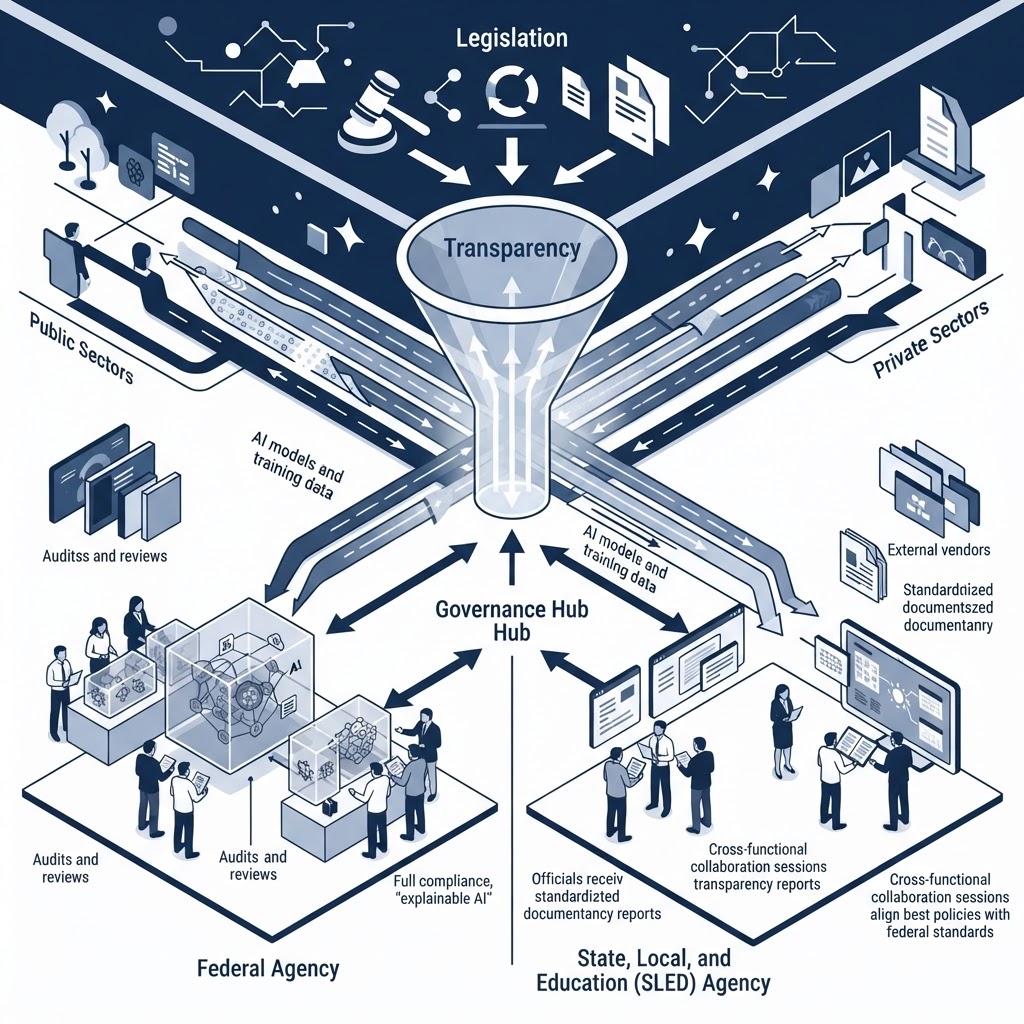
The federal government has officially accelerated AI transparency legislation this September, signaling a shift toward mandatory disclosure for generative AI foundation models. This legislative push is headlined by the formal processing of the AI Foundation Model Transparency Act on September 22, 2026, which joins a wave of recent safety-focused regulatory efforts. For government IT leaders, this shift necessitates immediate updates to procurement policies and algorithmic accountability protocols to ensure long-term compliance and risk management.
What is the status of the AI Foundation Model Transparency Act as of September 2026?
The AI Foundation Model Transparency Act was formally processed in the federal legislative system on September 22, 2026. This act serves as a pillar of current AI transparency legislation, aiming to enforce disclosure requirements for developers of large-scale generative AI models. It complements other legislative efforts, such as the Artificial Intelligence Training Data Transparency Act, which specifically mandates increased visibility into the datasets used to train generative AI systems.
Escalating Federal Focus on AI Transparency Legislation
Legislative activity has intensified throughout September, reflecting a concerted effort by lawmakers to address the rapid deployment of generative AI across public and private sectors. According to the latest AI Legislative Update: September 25, 2026, Congress passed a series of bills focusing specifically on chatbot safety, medical authorization, and mental health protocols. These measures follow the earlier introduction of A 6578, the Artificial Intelligence Training Data Transparency Act, which focuses on the critical need for training data visibility.
By requiring developers to disclose information about the data powering these models, lawmakers aim to mitigate bias and improve the reliability of AI tools used in government decision-making. The AI Foundation Model Transparency Act represents the next logical step in this evolution, moving beyond simple data logs to demand comprehensive transparency regarding the architecture and logic of foundational AI. This is a critical development for agencies that rely on third-party models for administrative efficiency, as it establishes a uniform expectation for developer disclosure.
How do the new federal AI oversight mechanisms affect existing agency compliance timelines?
New federal oversight mechanisms established by executive order are set to become fully effective on October 1, 2026. Agencies must ensure that their current AI acceptable use policies and procurement frameworks are updated to account for these requirements. Failure to align with these federal standards by the deadline could result in significant compliance risks or the suspension of existing AI-driven software projects that lack required documentation.
Navigating the October 1 Compliance Deadline
The transition to a more regulated AI environment will arrive rapidly, with new oversight mechanisms becoming enforceable on October 1, 2026. As highlighted in the 2026 AI Compliance: Upcoming Laws Every Organization Needs to Know analysis, these federal mandates will require agencies to demonstrate a high degree of accountability in how they deploy and manage AI systems. The primary focus is on ensuring that agencies can provide evidence of explainable AI, which is vital for maintaining public trust when AI is used for government services.
Organizations should immediately conduct an audit of their current AI portfolio to identify potential gaps in compliance, specifically regarding documentation and training data provenance. Relying on opaque, 'black-box' models is increasingly unsustainable in this new regulatory climate, and risk mitigation strategies must prioritize transparent procurement practices. By shifting toward an AI governance charter that aligns with these federal expectations, agencies can avoid the pitfalls of shadow AI while promoting safe, efficient innovation.
Impacts on Municipal and State Agency Procurement
State, local, and education (SLED) agencies face unique challenges when integrating these sweeping federal transparency requirements into their local operations. The shift toward requiring vendor transparency means that procurement teams must now include specific contractual clauses mandating documentation of training data and model methodology. Departments that rely on automated systems for public service delivery, such as medical or mental health screenings, must ensure that their vendors align with the latest state and federal safety mandates.
Staff training is no longer an optional component but a mandatory part of AI governance, ensuring that personnel understand the implications of using AI in high-stakes environments. Furthermore, closing policy gaps requires a proactive approach, where municipalities collaborate to share best practices for evaluating vendor risk and ensuring that AI deployment remains within the bounds of evolving ethical guidelines. By treating transparency as a core procurement requirement, agencies can protect themselves from future regulatory exposure while simultaneously improving the quality of their public sector digital transformation initiatives.
Actionable Steps for Government Compliance Teams
- →Audit current AI software deployments against the upcoming October 1, 2026 federal oversight mandates. • Update procurement templates to explicitly require training data transparency from all generative AI vendors. • Review the requirements of the Artificial Intelligence Training Data Transparency Act (A 6578) to ensure current vendor contracts remain compliant. • Establish a cross-functional AI governance committee to oversee compliance with emerging federal transparency laws. • Implement a mandatory internal review process for any AI model utilized in high-stakes areas like medical authorization or public mental health services. • Document all existing AI risk management frameworks to align with updated federal guidance on explainable AI.
What are the potential regulatory consequences for agencies failing to comply with new transparency rules?
Agencies that do not comply with the new federal transparency rules by October 1, 2026, face significant regulatory exposure, including potential audits and the mandatory suspension of non-compliant software systems. Inaccurate documentation regarding the training data or safety features of foundational models could lead to legal liability, particularly in sensitive sectors such as medical authorization, potentially eroding public trust and undermining critical government service delivery initiatives.
The acceleration of AI transparency legislation underscores a new era of accountability for public sector technology deployment. By preparing for the October 1 deadline and strictly adhering to federal transparency mandates, agencies can successfully mitigate risk while continuing to harness the power of artificial intelligence. Governance leaders must remain vigilant as these regulations continue to evolve throughout the remainder of the year.
Tagged
About APEX AI Guardrails: We publish expert AI news and governance insights updated 4× daily. Our editorial team consists of retired government IT professionals, AI governance specialists, and compliance experts with deep experience in local government operations.
Related Articles
AI Governance
Mitigating AI Hallucination Risks: New October 2026 Strategies for Government Agencies
October 14, 2026
AI Governance
Deepfake Disinformation Threats: How Governments Are Responding to New October 2026 AI Election Risks
October 14, 2026
AI Governance
New October 2026 Federal Legislation Targets AI Transparency in Government Decision-Making
October 14, 2026